AWS vs Azure Comparison: Which Cloud Platform Is Better for Your Enterprise in 2026


AWS and Azure are the two dominant global cloud service providers, with AWS holding 32% of the market, followed closely by Azure at 23%. In the digital age, these platforms allow businesses to quickly innovate, improve operational efficiency, and grow resources on demand. However, choosing the right platform is vital, as it directly affects scalability, cost-effectiveness, and integration capabilities tailored to unique business demands.
Dealing With Integration Gaps & Vendor Lock-In? Learn Smarter Hybrid and Multi-Cloud Strategies

“The use of AI technologies in IT and business operations is unabatedly accelerating the role of cloud computing in supporting business operations and outcomes. 90% of organizations will adopt a hybrid cloud approach through 2027, and the most urgent Gen AI challenge necessary to address over the next year will be data synchronization across the hybrid cloud environment.”– Gartner
Amazon Web Services (AWS): Powering Scalable Cloud Infrastructure
One of the most popular options for businesses looking to take advantage of cloud computing is AWS. The most comprehensive and well-known cloud platform, AWS (Amazon Web Services), provides over 200 fully functional services from multiple data centers.
Infrastructure as a Service (IaaS), Platform as a Service (PaaS), and Software as a Service (SaaS) are all included in this cloud platform. AWS service offerings include resources, such as user database storage, content delivery services, and processing power.
Millions of enterprise clients ranging from the growing startups to established enterprises and even government bodies trust AWS for decreasing costs and bringing agility. AWS facilitates innovation and gives businesses a seamless, safe experience.
How AWS Accelerates Modern Cloud Application Development: Key Benefits
Here are some of the greatest benefits of Amazon Web Services (AWS):
- Diverse Set of Solutions: AWS can meet all your cloud computing requirements. In addition to cloud computing and storage, the platform offers over 200 fully managed and self-managed services, including relational database management, networking, data analysis, and more.
- Scalability: You need an infrastructure that can manage peak times without sacrificing speed if the demand for your app or website fluctuates. In the past, this would mean making significant resource investments merely to “survive” times of high demand. Fortunately, AWS doesn’t have this problem. Scalability in AWS means that your resources may automatically scale up and down to meet demand.
- Global Infrastructure: With its vast global network of strategically placed, interconnected data centers, AWS boasts an impressive global infrastructure. It improves resource security through ongoing encryption and monitoring.
Where AWS Outperforms Other Cloud Platforms
Compared to Azure, which offers more than 100 services, AWS has developed the largest range of services, more than 160, because it has had more time to mature in the market. These consist of databases, computing, storage, quality assurance testing, analytics, mobile software development, Android app development, iOS app development, a dedicated development team, networking, enterprise applications, DevOps as a service, the Internet of Things, and software product development tools.
In addition, AWS demonstrates stronger alignment with open-source ecosystems and greater flexibility across workloads. Below are key factors that often lead organizations to prefer AWS:
- High-speed EBS storage optimized for big data workloads
- Native long-term data archiving through Amazon Glacier
- Independent access to compute instances
- Minimal data loss during storage or server migration
Microsoft Azure: An End-to-End Cloud Computing Ecosystem
Microsoft Azure, formerly known as Windows Azure until 2014, is a robust cloud computing platform that helps developers create, launch, and maintain custom applications. Azure is capable in a number of areas, such as compute, storage, database delivery, and migration.
Azure also supports development, testing, deployment, and management. Businesses can communicate and keep any kind of data between virtual machines (VMs). Because of this, 95% of Fortune 500 organizations rely on Azure.
Why Choose Microsoft Azure: Key Benefits Explained
Microsoft Azure provides a wide range of benefits, including:
- Large Global Footprint: Azure has an incredible global footprint with 60+ regions worldwide and over 300 highly secure data facilities within them. To ensure the least amount of delay, it can deploy your apps close to end consumers. It can provide incredibly quick and responsive experiences. Also, fulfill the necessary compliance requirements for keeping private data (such as medical histories or patient records) in a designated area.
- Enterprise Expertise: Although Azure serves companies of all sizes, its enterprise-level assistance is where it really shines. It specializes in handling mission-critical workloads, making it a preferred choice for major enterprises. In fact, several Fortune 500 companies, such as SAP and Databricks, rely on Azure for their cloud computing needs.
Why Azure Holds a Competitive Advantage
Most large companies, particularly those subject to strict regulations, would rather reduce risk by first storing most of their services in their own facilities and only a fraction of them in the public cloud. Compared to AWS, Microsoft Azure manages these hybrid operations far more smoothly.
Microsoft, as a legacy software company itself, has a stronger grasp of an enterprise’s legacy software migration needs, rendering these migrations simple and hassle-free. Additionally, it has benefited from the fact that it already has clients utilizing a range of its services, including on-premises systems like Windows Server and Windows Directory, and has transferred these clients’ licenses to Azure with minimal difficulty.
Here are a few additional reasons organizations choose Azure:
- Stronger support for cloud development, software testing, and government workloads
- Greater depth across IaaS and PaaS service offerings
- Elastic load balancing is designed to handle all incoming requests
Accelerate Big Data Analytics Using AWS Redshift or Azure Synapse with Optimized Query Performance
AWS vs Azure Comparison: Comparing Capabilities, Scale, and Enterprise Readiness
One of the key distinctions in the AWS vs Azure comparison is their core strengths. AWS stands out for its extensive service portfolio and superior raw computing power, while Azure is widely recognized for its seamless integration with Microsoft products and services, making it an ideal choice for organizations already embedded in the Microsoft ecosystem.
Despite these differences, both platforms deliver comparable core cloud services, including compute, storage, databases, and networking. To help you determine which platform best aligns with your business needs, let’s explore a detailed AWS vs Azure comparison.
 1. AWS vs Azure Comparison: Computing Power
 1. AWS vs Azure Comparison: Computing Power
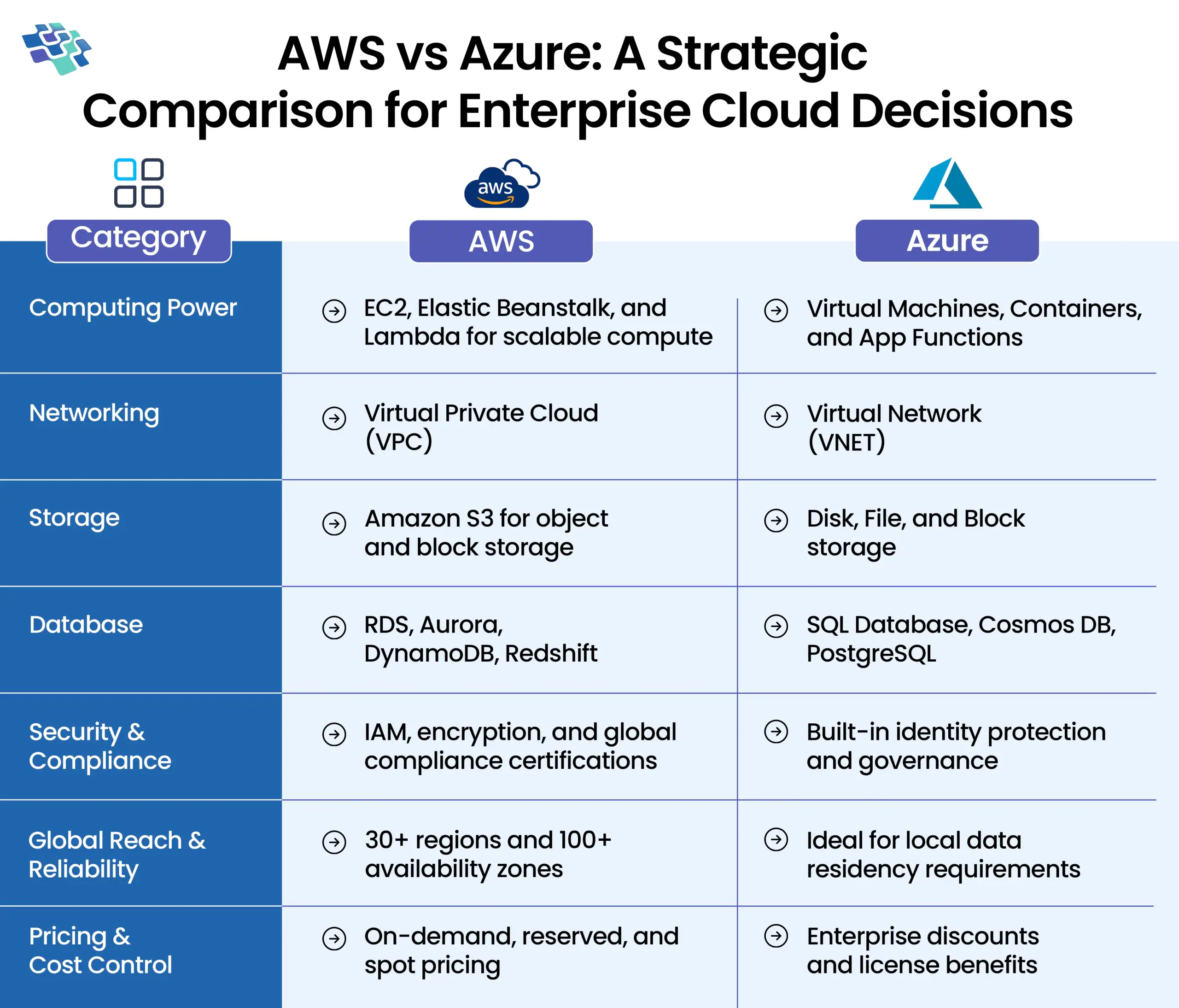
AWS: Two of AWS’s top computing services are E2C (Elastic Compute Cloud) from Amazon Elastic Beanstalk and AWS Lamda. They offer a lot of agility and can automatically scale and monitor your cloud apps. Additionally, AWS offers its own proprietary innovations, such as Kubernetes services. You can select an operating system with the assistance of a range of Amazon Machine Images (AMI) available in the Marketplace.
Azure: When comparing AWS and Azure services, Azure is one of the top cloud computing providers. It operates with virtual machines, container services, application functions, and various infrastructures. In the Azure Marketplace, you can select from templates for SQL Server, Firewall, Ubuntu, NextGen WebApp, SharePoint Server, Red Hat Linux, or Windows Server. You may choose your desired market region and the standard virtual machine size.
2. AWS vs Azure Comparison: Networking
AWS: Amazon gives its clients a virtual private cloud (VPC) and ensures persistent, reliable administrations employing a broad structure spanning 210 edge locations in global countries. As a result, they are prepared to respond, convey, and organize at lightning speed.
Azure: Microsoft offers its clients a virtual network (VNET) with a presence in over 60 global regions. They can deliver services that are secure, flexible, and rapid due to their tendency to maintain traffic within the Azure network.
3. AWS vs Azure Comparison: Storage
AWS: AWS’s Simple Storage Service (S3) provides efficient storage and delivery of data, serving as the industry-standard solution for objects and large blocks.
Azure: Azure offers import-export services, site recovery, and supplementary backup solutions for data retrieval and archiving. Azure’s principal storage solution is Microsoft’s cloud, meticulously engineered to resolve your existing data storage challenges. Azure efficiently manages your temporary data utilizing disk drives, file system services, and blocks.
4. AWS vs Azure Comparison: Database
AWS: AWS offers RDS, Aurora, DynamoDB, and Redshift. All these databases accommodate the flexibility required for relational, NoSQL, and data warehousing purposes. They are superior to organizations with varied database types. Engage AWS developers to deliver robust support for transitioning from relational to NoSQL databases, necessitating extensive data warehousing.
Azure: It includes SQL Database, Cosmos DB, and Azure Database for PostgreSQL. All of them endorse both relational and NoSQL databases. Optimal for organizations centered on Microsoft technology or need integrated enterprise-level tools.
5. AWS vs Azure Comparison: Security & Compliance
AWS: It offers encryption, Identity and Access Management controls, and compliance certifications. All these security-regulated gadgets safeguard your system. They also offer sophisticated monitoring in accordance with AWS monitoring best practices. It is particularly the optimal selection for organizations pursuing comprehensive security measures and international compliance alternatives.
Azure: It provides identity protection, data governance, and integrated compliance solutions. This solution is suitable for teams seeking robust cloud governance. Microsoft offers very dependable security tools for hybrid protection and unified identity management.
6. AWS vs Azure Comparison: Global Reach & Reliability
AWS: AWS possesses an extensive worldwide footprint, featuring data centers in more than 30 regions and exceeding 100 availability zones. This configuration ensures increased reliability, rapid performance, and robust failover support. AWS is an optimal choice for enterprises developing cloud-based applications with a global user base.
Azure: Azure encompasses more worldwide regions than AWS, making it an astute option for organizations requiring data compliance across international boundaries. It is advantageous for enterprises that have a clientele across several nations. If your cloud application development necessitates adherence to stringent local data regulations, Azure is the optimal selection.
7. AWS vs Azure Comparison: Pricing Models & Cost Control
AWS: AWS offers adaptable pricing through options such as on-demand, reserved, and spot instances. It has a pricing calculator to assist in estimating expenses. However, with numerous options available, monitoring expenditures can become challenging.
Azure: Azure facilitates cost-saving for organizations already utilizing Microsoft solutions. It provides reductions for extended plans and holders of Microsoft licenses. For the development of enterprise-level cloud applications, Azure serves as an optimal platform that aids in maintaining budgetary constraints.
Implement High-Speed Data Processing Using AWS Lambda or Azure Functions for Scalable Cloud Workloads
AWS vs Azure Comparison: Industry-Specific Considerations
When evaluating AWS against Azure, assessing the specific requirements of your industry can yield greater insight.
For Healthcare Organizations
Healthcare organizations possess distinct requirements, particularly regarding data privacy and regulatory adherence. AWS provides robust capabilities for managing extensive information, but its policies regarding custom Business Associate Agreements (BAAs) may present a barrier. This renders Azure and other providers, such as Google Cloud Platform (GCP), appealing alternatives for healthcare organizations seeking greater flexibility in their contracts.
For Financial Services
AWS has a significant presence in the financial sector, including comprehensive security capabilities essential for managing sensitive financial information. Nonetheless, Azure is advancing in this domain by providing adherence to numerous international standards, which may be a crucial element for global financial institutions.
AWS vs Azure: How to Select the Right Cloud Platform
There’s a fair likelihood that current architectural infrastructures would also help explain the differences between Azure vs AWS. Because Azure is easily connected with other Office products, SQL Server, and Active Directory, the development shift towards Azure would be much simpler if a company runs most, if not all, of its apps on Microsoft platforms.
Conversely, if greater service variety and further customization are desired, AWS Cloud is wider in this area. Both are strong; nevertheless, the difference resides in how the long-term outlook is created and how the abilities are assigned within.
The choice between Azure vs Asure comes down to business fit rather than feature count. While setup differences between AWS and Azure can influence long-term replacement and operational costs, neither platform is inherently superior. The better option is the one that aligns most closely with your existing systems, technical requirements, and strategic goals.
2026 and Beyond: Why Cloud Is the Future of Financial Services Infrastructure
Below are a few reasons that demonstrate the cloud’s potential in the future.
- Serverless Architecture: Serverless architecture is beneficial since it eliminates issues such as system administration, expenses, liabilities, and others. Users can utilize the cloud without the necessity of acquiring any servers to manage their info. They merely require cloud storage to retain data and access it, as necessary.
- Application Resiliency: The application’s uptime has consistently been significant. Currently, its availability is more crucial than ever as numerous industries embrace digital transformation to evolve into digital enterprises. These digital advancements render application resiliency increasingly vital. Nonetheless, cloud computing alters the equation of resiliency. This is due to the ease of acquiring supplementary infrastructure resources.
- Advanced Security: Advancements in cloud environments mitigate security issues. Currently, the cloud is merging with Machine Learning in AWS, enabling the automation of numerous activities. The most effective technique assists in threat identification and prevention. Consequently, cloud security is evolving to be more complex and dependable.
How Can NextGen Invent Help?
AWS and Azure provide robust, comprehensive services, although they cater to distinct business objectives. AWS offers unparalleled service diversity and expertise, rendering it optimal for enterprises pursuing resilient infrastructure and development tools. Azure excels in ecosystems fundamentally based on Microsoft technologies and hybrid cloud applications.
For modern businesses, progress is driven by smart integration rather than complete replacement. The decision isn’t about which platform is better overall, but which one best fits your business needs. That choice depends on your existing ecosystem, technical priorities, and long-term objectives. In many cases, a hybrid or multi-cloud approach delivers the greatest value by leveraging the strengths of both platforms.
Integrating legacy systems, maintaining data privacy, and managing inconsistent data formats remain major challenges for healthcare organizations. Partnering with an experienced artificial intelligence development services company can help address these issues through secure, customized software solutions.
- Develop Custom Cloud Platforms: Develop safe, scalable, and compliant systems on AWS or Azure, customized for your company’s needs.
- Build Interoperable Applications: Design and create strong analytics dashboards, support tools, and other apps that harness the full capability of a multi-cloud strategy.
- Manage Legacy System Integration: Create data transformation methods to connect legacy on-site systems with new cloud configurations.
Talk to our experts to see how NextGen Invent can help improve how you handle interoperability. We bridge the gap between historical systems and current cloud solutions with safe, reliable, and custom-built platforms.
Frequently Asked Questions About AWS vs Azure Comparison

“Choosing between AWS and Azure in 2026 isn’t about feature supremacy; it’s about strategic alignment. Enterprises that succeed evaluate cloud platforms through the lens of scalability, ecosystem fit, governance, and long-term business value, not short-term technical advantages.”
Nitin Kumar

AVP, Data Science
Related Blogs

Data Warehouse in Microsoft Fabric: Powering the Next Generation of Unified Analytics
Microsoft Fabric addresses this need through a unified analytics platform that seamlessly integrates data engineering, data science, real-time analytics, data warehousing, and business intelligence into a single, cohesive experience.
Data Mining for Business Intelligence: How Can It Help?
One of the most essential abilities for business success nowadays is the ability to derive significant insights from large amounts of data through data-driven initiatives. Fundamentally, data mining is more than just a trendy term in IT.
Benefits of Data Lake: Why Does Your Business Need Data Lake?
In the current world where big data is a primary resource for research and commercial decision-making, a data lake is a repository that is already considered essential.
Stay In the Know
Get Latest updates and industry insights every month.