AI Beyond the Hype: An Executive View on AI in Biopharma Data Ecosystems, Drug Discovery, and Value Realization


Deepak shares a clear point of view on why data ecosystems, not isolated enterprise AI strategies, will shape the future of biopharma, and how organizations can unlock value even with fragmented, limited, or non-traditional datasets. He also highlighted why AI governance must start with business strategy, enabling not just control and compliance, but measurable ROI and value-based pricing models. The conversation further explores partnership criteria, evolving deal structures, and critical lessons from scaling AI in real-world environments, offering a practical, experience-driven perspective for leaders looking to translate AI ambition into tangible business outcomes.

“Gartner says AI governance should be considered from the first day of AI architecture. However, we strongly disagree with that approach. It should start from the first day of product and business strategy. In our opinion, AI Governance can be leveraged by innovative companies to transform their product pricing model from a SaaS pricing model to a value-based pricing model.” — Deepak Mittal, Founder & CEO, NextGen Invent
Scaling AI in Biopharma Data Ecosystems: Partnerships, Data Strategy, and the Path to Real Value
Driving real impact with AI in biopharma data ecosystems requires more than technology; it demands the right data strategy, partnerships, governance, and execution discipline. This interview explores how organizations are scaling AI to deliver measurable value across the biopharma lifecycle.
Dan Bushell: Please Introduce Yourself, Your Organization, and the AI Initiatives You Are Most Focused on Right Now.
Deepak Mittal: I am the CEO and Founder of NextGen Invent. My core expertise lies in transforming organizations into AI-enabled enterprises. Over the years, I have had the opportunity to serve as a technology advisor to multiple organizations, supporting their journey from early-stage startups to successful unicorns.
NextGen Invent is a global AI-Enablement and IT services company focused on the healthcare and life sciences sector. Our work is centered on helping organizations unlock the full potential of AI across their value chain. To date, we have successfully built and deployed more than 500 enterprise-grade AI models that are live and creating impact within organizations. Our capabilities span the entire lifecycle of drug innovation and commercialization. We have developed AI solutions in areas such as drug discovery, including next-generation sequencing and proteomics, as well as clinical trials, regulatory submissions, drug forecasting, market access, and product commercialization.
We are a growing organization of 250+ professionals, supported by a highly specialized data science team. This includes more than 25 PhDs in fields such as computational biology and bioinformatics, bringing deep domain expertise and scientific rigor to everything we build.
Dan Bushell: When evaluating a potential partner, whether an AI firm or a biopharma organization, what foundational qualities and strategic signals do you prioritize?
Deepak Mittal: When evaluating a potential partner, whether an AI firm or a biopharma organization, we focus on a few foundational qualities that signal long-term alignment and readiness for transformation.
- First, we look for organizations that have already reached a point of realization that they want to transition from being Good to Great. This means they are no longer satisfied with their current state and are actively seeking ways to evolve, innovate, and differentiate themselves in a meaningful way.
- Second, it is critical that the organization genuinely believes that AI can act as an accelerator on that journey from Good to Great.
Once the above two parameters are in place, clarity of intent and belief in AI, we can take full ownership of the journey ahead. This includes defining what the right AI interventions should be, identifying high-impact use cases, prioritizing them based on business value, and then scaling those solutions effectively. We also focus on training the organization to adopt these capabilities and establishing strong AI governance frameworks.
Dan Bushell: Across fee-for-service, milestone-based, and outcome-driven engagements, which partnership models have proven most effective in delivering sustainable value for your organization?
Deepak Mittal: We work across all three partnership models- fee-for-service, milestone-based, and outcome-driven engagements– depending on the needs, maturity, and strategic objectives of the organization.
- In our partnerships, a key principle is that the client retains ownership of intellectual property. This is especially important in biopharma, where proprietary data and models are core to long-term competitive advantage.
- Co-development has also emerged as a significant and growing model. In this approach, we work closely with our partners to jointly build solutions, combining our AI expertise with their domain knowledge and data assets.
- In addition, we leverage proprietary accelerators to speed up development and deployment. These accelerators allow organizations to fast-track their AI initiatives while benefiting from pre-built capabilities. In many cases, partners receive a perpetual, royalty-free license to these accelerators.
Dan Bushell: Given that data is a foundational asset in these partnerships, how do you gain access to both proprietary internal and external data sources? What are some of the biggest challenges you’ve faced with data for AI initiatives?
Deepak Mittal: Data is a foundational asset in any AI-driven partnership, and gaining access to both proprietary internal and external data requires a multi-pronged approach. We leverage data crawling techniques to capture real-time and real-world data at scale. In addition, we invest in acquiring licensed datasets from established providers. Beyond that, we also build proprietary datasets. For example, we created obituary-based datasets using over 40K records to establish one of the most comprehensive mortality datasets in the United States.
However, despite these efforts, there are several structural challenges that organizations consistently face.
- First, data sharing remains a major barrier. Many companies do not want to share data (De-identification). This becomes even more complex in large-scale healthcare data environments, such as healthcare data hubs that involve data from over 3K hospitals and 75 payers.
- Second, companies did not want to share their models. Particularly in domains like proteomics, organizations are often reluctant to share not just their data, but also their models. To address this, a neutral platform was created where neither party can access each other’s information, and organizations with data can use the AI model as a complete black box without the data leaving their environment.
- Third, data linkage is inherently complex. While working on drug commercialization, we used 16 datasets.
We are experts in de-identification of data. For Datavant, we architected those solutions, including creating a label intelligence platform, where we crawled everything needed for label intelligence and related use cases.
Dan Bushell: Across the biopharma value chain, from target identification and trial design to manufacturing and beyond, where have you seen AI deliver tangible returns? Conversely, where has the promise so far outpaced reality?
Deepak Mittal: AI can deliver value across multiple stages of the biopharma pipeline, but it is important to first define what “value” truly means for an organization. In our view, any AI model can bring certain value to the organization.
The most fundamental value is enabling new products and services, because without innovation, there is no company. Beyond that, AI creates a competitive advantage, allowing organizations to differentiate in a complex and regulated market. Equally important is cost optimization, where AI helps organizations accomplish significantly more with fewer resources and within tighter budgets.
However, many of the industry’s expectations are built on certain assumptions, primarily around data availability and data quality. We are breaking those barriers by working with less data, adopting new business models, and building better data ecosystems, including healthcare platforms like the Mayo Clinic data platform.
At the same time, there is still a clear gap between innovation and realization. While the capability to build AI solutions exists, translating that into consistent, scalable business outcomes remains a challenge. This gap is further amplified by the broader AI hype cycle, where expectations often outpace what can realistically be delivered in real-world environments.
Dan Bushell: Reflecting on your experience, what is the most critical lesson you have learned from AI partnerships that either fell short of expectations or surpassed them significantly?
Deepak Mittal: MIT says that only 15% of AI initiatives meet their objectives. Why is it higher when we partner?
- AI Governance as an Accelerator:
Gartner says AI governance should be considered from the first day of AI architecture. However, we strongly disagree with that approach. It should start with the first day of product and business strategy discussion, including AI safety, AI trust, and AI explainability.
For example, in organizations with SaaS-based products, we have been able to shift traditional pricing models toward value-based pricing. This is enabled by strong AI observability and monitoring frameworks. Pricing is no longer static; instead, it is tied to measurable impact, such as how much time a specific agent, agentic workflow, or prompt has saved.
- Breaking Data Assumptions:
You do not need extremely clean data. Even emails can be used as data. In cases where sufficient data is not available, approaches like synthetic data can help bridge the gap and enable progress.
- Concentrate on Value Pull and Technology Push:
At the same time, it is important to balance value pull and technology push. Many organizations focus too heavily on what technology can do, rather than aligning it with where real business value is needed. Successful AI initiatives strike the right balance between these two forces.
- Focus on Change Management:
From our experience, one of the biggest lessons is that change management is the key. Organizations invest time and effort in building AI solutions, but do not invest equally in scaling them. People create AI, but they do not spend the same level of effort in driving adoption across the organization. Without strong change management, even well-built AI solutions fail to deliver meaningful impact.
- Rethinking AI Prioritization Approaches:
We also completely disagree with Gartner’s approach to AI prioritization and identification. Traditional models recommend evaluating value and feasibility together. Our approach is different; we first do a round of elimination, and only then move to prioritization. This sequential approach is far more effective than trying to perform elimination and prioritization in parallel, as it creates better focus and clearer decision-making.
Dan Bushell: Looking ahead, in which areas do you believe the industry continues to underestimate AI’s potential? What shifts in regulation, data infrastructure, or organizational culture are required to realize that potential fully?
Deepak Mittal: We believe the industry is still underestimating AI’s potential by limiting its thinking to enterprise AI, rather than evolving toward ecosystem AI.
Today, most organizations focus on optimizing their own internal processes and capabilities. However, the real opportunity lies in moving beyond this mindset and thinking about how AI can influence and integrate across the entire ecosystem.
This means not just improving internal operations but also enabling collaboration and value creation across all stakeholders, partners, data providers, customers, and other participants in the broader biopharma ecosystem.
To truly unlock AI’s potential, organizations need to shift their perspective toward building interconnected systems where value flows across the ecosystem, rather than being confined within a single enterprise.
Wrapping Up
The interview underscores a critical shift in how AI must be approached in biopharma, not as a technology initiative, but as a business transformation lever grounded in data, governance, and ecosystem thinking. From redefining partnership models and challenging long-held data assumptions to embedding governance at the strategy level, this interview makes it clear that sustainable value from AI comes from disciplined execution, not experimentation alone.
A key takeaway is the growing importance of AI in biopharma data ecosystems, where competitive advantages will be defined by an organization’s ability to move beyond siloed systems and orchestrate value across partners, data providers, and stakeholders. This evolution enables not only better innovation but also new commercial models, including value-based pricing driven by measurable outcomes.
Looking ahead, organizations that invest in data accessibility, AI observability, and change management, while aligning technology with business value, will lead the next wave of transformation. Those that successfully transition from enterprise AI to ecosystem-wide intelligence will unlock scalable impact, stronger market positioning, and long-term competitive advantage in an increasingly data-driven industry.
Speaker

Deepak Mittal is an accomplished serial entrepreneur with a proven track record in product, AI, and data strategy. He is experienced in transforming an organization into an AI-enabled organization. Currently, Deepak holds the Founder & CEO position of NextGen Invent Corporation, a leading global professional services company that has always been at the forefront of providing solutions using disruptive technologies such as Agentic AI, Computer Vision, and Intelligent Automation. During his career, Deepak has served as a member of the Board of Directors of many companies, including D4DT, Optym, CMR Institute, CBS Alum Club of New York, and Launch Right Now. He is a strategic advisor to various organizations that grew from small start-ups to unicorns or had successful exits. Deepak holds expertise in evaluating new product ideas, devising an appropriate product and AI strategy, transforming organizations into insight-driven organizations, and structuring strategic partnerships. Deepak has an MBA from Columbia Business School and an M.S. in Industrial Management Engineering from the Indian Institute of Technology.
Deepak Mittal

Founder & CEO, NextGen Invent

Dan is a senior life sciences executive and business technology liaison at the intersection of life sciences and emerging technology, architecting AI-enabled solutions that unlock operational excellence and accelerate therapeutic innovation. His extensive experience across biopharma functions, from discovery to commercial operations, enables him to identify high-impact opportunities where AI transforms data into actionable intelligence, streamlines complex workflows, and delivers measurable business outcomes that create competitive advantage and drive the future of drug development and commercialization. He has previously worked for biopharma companies such as Merck, Genentech, Gilead, and Genmab in commercial, medical affairs, alliance management, and business development roles. Dan has an MBA from Duke University and a B.S. in chemical engineering from Northwestern University.
Dan Bushell
Founder & Principal, AI Bio Advisors
Related Blogs
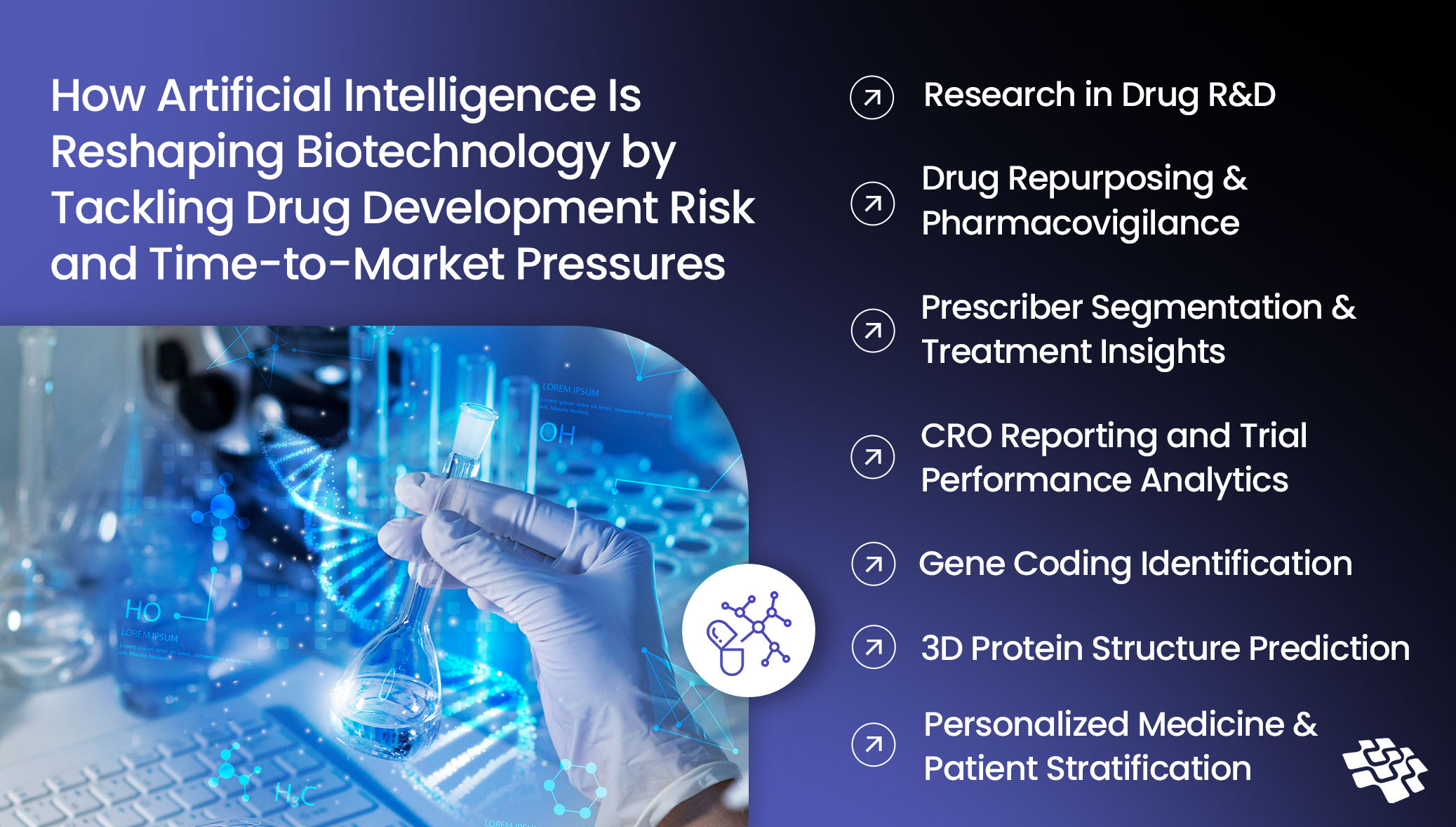
AI in Biotech: Solving R&D Complexity, Data Silos, and Time-to-Market Pressures for Life Sciences Innovators
As more and more pharmaceutical companies use AI in biopharma to expedite and simplify their development processes, the technology has already had a tremendous influence...
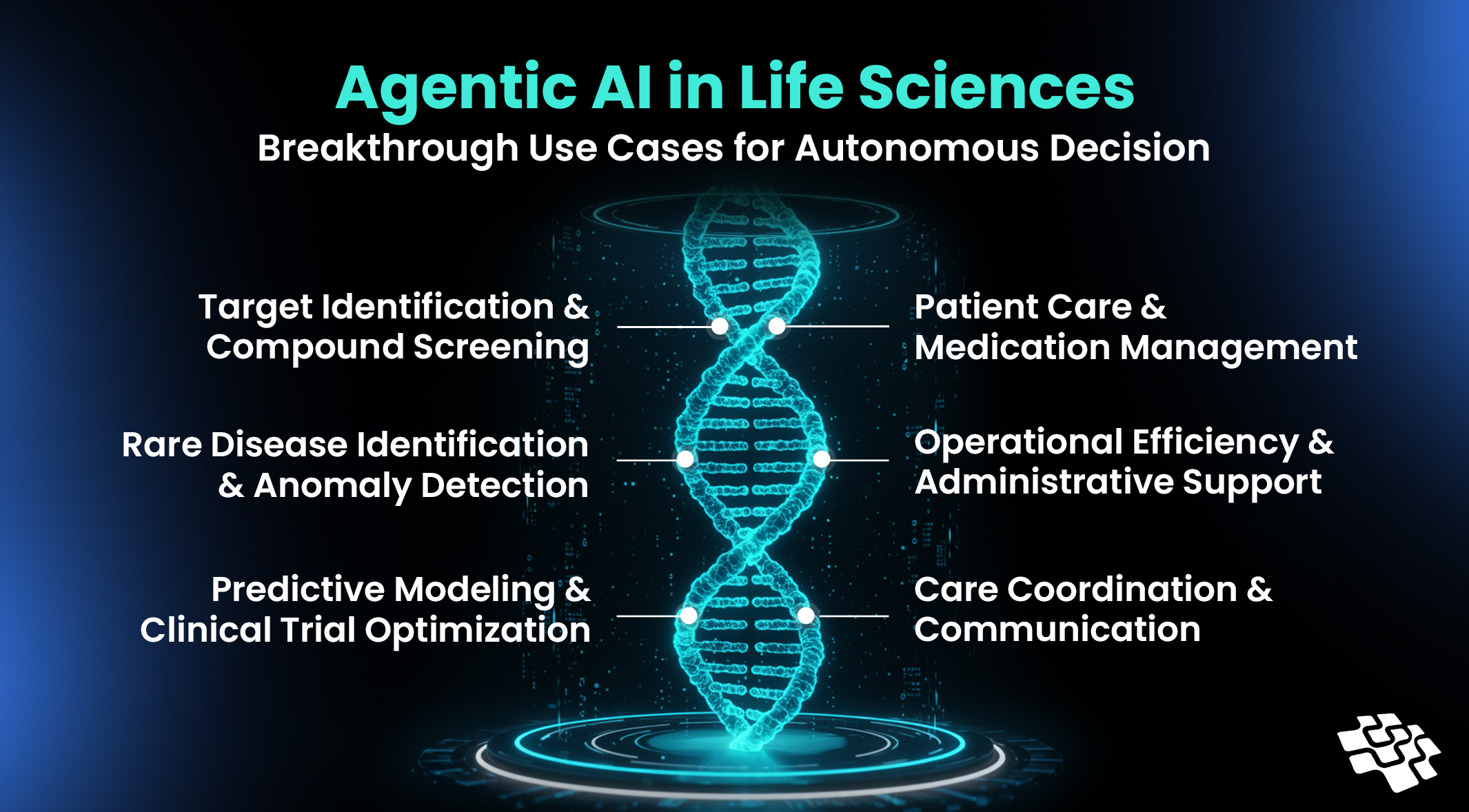
From Trial Delays to Smart Decisions: How Agentic AI In Life Sciences Is Redefining Innovation
Traditional drug development processes are time-consuming and face a 90% failure rate. Data analysis for enhancing operations and R&D is hampered by inadequate digital connectivity.
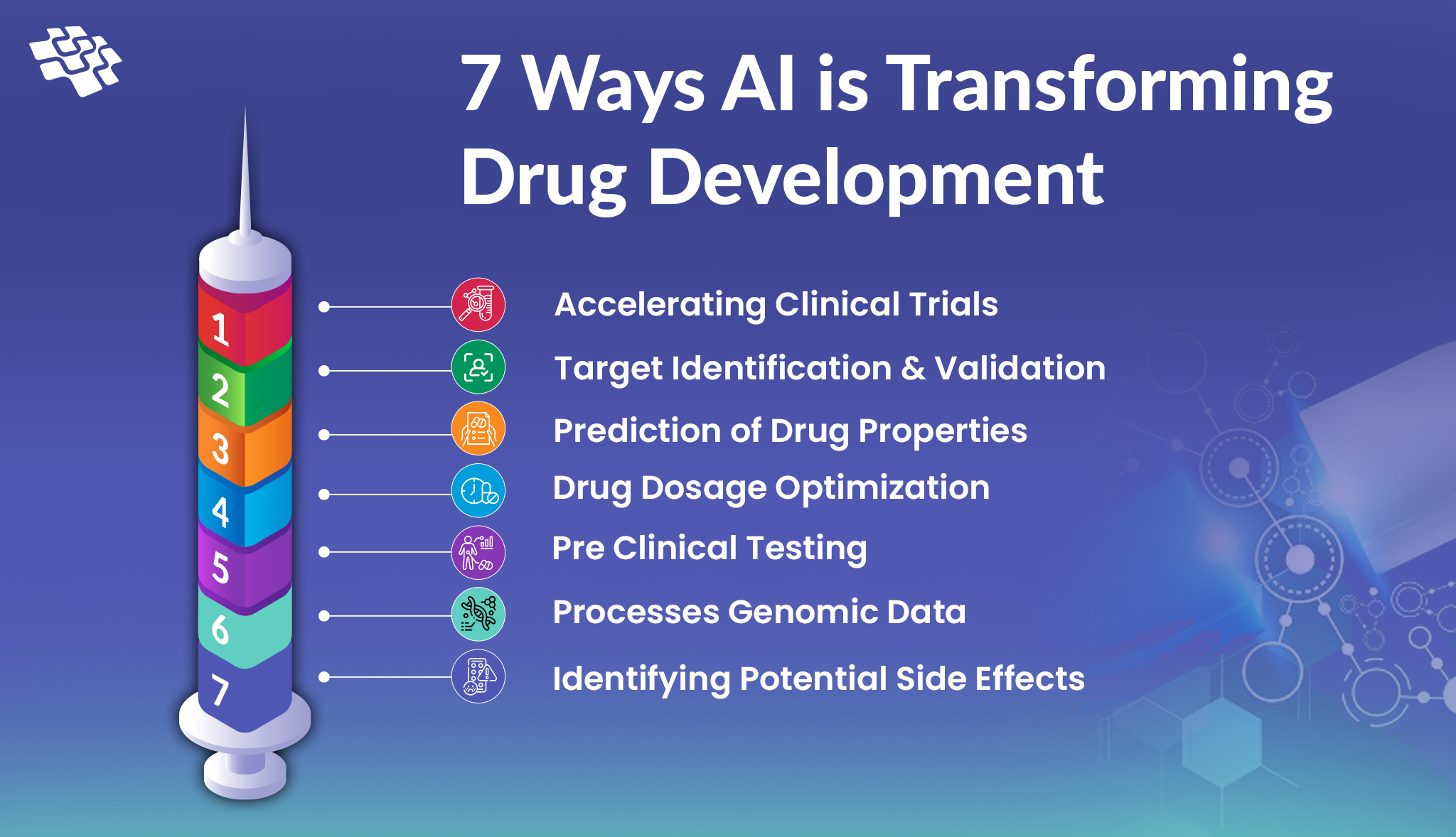
How AI in Drug Development is Transforming the Industry?
Across all therapeutic categories globally, the success rate in drug development is extremely low; for instance, 97% of cancer treatments fail during clinical trials.
Stay In the Know
Get Latest updates and industry insights every month.