Agentic AI vs LLMs: What’s the Real Difference That Impacts Your Business?


Agentic AI is a revolutionary step beyond static models and has been one of the hottest issues among businesses for a long time. The autonomous, goal-directed, and adaptive capabilities of Agentic AI systems are combined with the contextual intelligence and natural language skills of LLMs in this integration. Let’s explore the blog in more detail and discover more about Agentic AI vs LLMs.

Transform LLM Insights into Real Actions with Agentic AI Systems Built for End-To-End Workflow Automation

“To scale impact in the agentic era, organizations must reset their AI transformation approaches from scattered initiatives to strategic programs, from use cases to business processes, from siloed AI teams to cross-functional transformation squads, and from experimentation to industrialized, scalable delivery.”– McKinsey
Agentic AI vs LLMs: How LLM Advancements Fueled the Rise of Agentic AI
The AI landscape is always changing, from the development of strong LLMs like GPT-3 and GPT-4 to the rise of agentic AI. LLM models that have been trained on vast quantities of data to analyze, understand, and generate human-like language make conversation seem realistic.
One could argue that LLMs and their tools are propelling agentic AI. It improves the capacity to interpret natural language and enables AI agents to understand complicated inquiries. It also creates opportunities for multi-step problem-solving and human-like engagement, which is more intuitive and natural.
The ability to reason and independently make decisions based on the data they process using tools is one feature that sets Agentic AI apart from conventional automation systems. AI systems examine enormous volumes of data and spot trends. These agents use this information to produce insights, forecasts, and actions that support your company’s goals.
How LLMs Power Modern Heterogeneous AI Architectures
LLMs remain highly relevant in modern AI systems. They are especially valuable for open-ended conversations, human-like communication, cross-domain reasoning, and complex problems that require multiple steps. In these situations, their broad knowledge and general reasoning abilities are still difficult to match.
In the Agentic AI vs LLMs discussion, the future is not about replacing one with the other. Instead, it is about smartly combining different models.
- Smaller models (SLMs) often handle routine and operational tasks because they are faster, more efficient, and specialized.
- LLMs are used when deeper reasoning, broader context, or advanced interaction is required.
You can think of it like a digital organization: SLMs act as skilled employees who complete most daily tasks, while LLMs step in like expert consultants when complex thinking or wide expertise is needed. This hybrid approach is shaping the next generation of AI architectures.
Agentic AI vs Generative AI: Understanding the Key Differences
First, it is necessary to establish the distinctions between generative AI and agentic AI.
- Generative AI: It is a type of artificial intelligence that can generate original content, such as words, images, videos, audio, or software code, in response to a user’s prompt or request. Generative AI depends on machine learning models known as deep learning models, algorithms that replicate the learning and decision-making processes of the human brain, along with other technologies such as robotic process automation. These models function by recognizing and encoding patterns and correlations throughout vast datasets, then utilizing that information to comprehend customers’ natural language inquiries or requests.
- Agentic AI: It refers to AI systems engineered to independently make decisions and act, capable of pursuing intricate objectives with minimal oversight. It integrates the adaptable features of LLMs with the precision of conventional programming. It is a proactive AI-driven methodology, whereas generative AI is responsive to user input. Agentic AI possesses the ability to adjust to varying or evolving circumstances and has the capacity to make judgments informed by context. It is utilized in diverse applications that can benefit from autonomous functioning, including robots, intricate analysis, and virtual assistants.
When Should You Choose Agentic AI vs LLMs?
You can choose between Agentic AI vs LLM based on whether you want AI to help you or act.
When Is Agentic AI the Right Choice for a Business?
When automation, execution, and decision-making are the desired outcomes rather than merely recommendations, agentic AI is the best option.
- AI needs to execute actions, not just generate responses
- Workflows span multiple steps across systems and tools
- Decisions must rely on real-time data insights
- Operations must run continuously with minimal human oversight
When Is LLM the Right Choice for a Business?
When content development or idea support is your main objective, you should use LLMs. It functions best when humans maintain control, and the AI serves as a helper.
- Require support for writing, brainstorming, design, or research
- Human review and final decision-making remain essential
- Require fast outputs with minimal setup or configuration
- Tasks emphasize creativity over automated execution
The Ultimate Benefits of Agentic AI vs LLMs
Key Benefits of Agentic AI
- High Adaptability in Complex & Dynamic Environments: When things change, traditional systems often stop working. But agentic AI can adapt better. If something out of the ordinary happens, like a sudden problem with the supply line, it can recalculate and keep working. Because it can be changed, it works better in messy and uncertain real-life settings.
- Self-Directed Tasks: The best thing about agentic AI is that it doesn’t need to be watched over. The goal can move things forward on its own after it’s been set. This makes it extremely useful when you don’t have time to micromanage or give step-by-step directions all the time.
- Autonomous Decision-Making Capabilities: When AI is agentic, it can think about its options and choose a way instead of just reacting. It can handle cases where it’s not clear what the “next step” is. For businesses, that saves time and means workers don’t have to do as many simple or complicated jobs.
Key Benefits of LLMs
- Language Understanding: When it comes to working with natural language, LLMs excel. They can decipher the objective of a messy question and provide a natural response. Because of this, they can be used for several tasks, such as customer service, content creation, and making technical material easier to understand for a larger audience.
- Scalability for Text-Based Applications: Once configured, an LLM can scale to hundreds or thousands of applications without experiencing a significant performance decline. One of the primary reasons businesses use them is their capacity to grow quickly, whether they are used for client interactions, content creation, or answering frequently asked questions.
The Role of LLMs in Agentic AI Systems
Agentic AI systems are distinct from traditional AI since they possess the capability to plan, execute actions, and make independent judgments. To accomplish this, they depend on LLMs for certain essential functions:
1. Understanding Intent & Context
Large Language Models empower AI agents to comprehend intricate human directives. For example, when a user requests, “Identify potential suppliers in the USA and summarize their pricing policies,” a large language model breaks this operation into methodical steps: searching, filtering, and summarizing the information. This contextual comprehension enables Agentic AI to operate intelligently rather than mechanically.
2. Collaboration in Multi-Agent Systems
Advanced environments are characterized by the collaboration of numerous AI agents, each of which is powered by LLMs, to achieve common objectives. For instance, one agent summarizes market reports, another evaluates financial risk, and a third generates visual dashboards. LLMs facilitate seamless communication among these agents, enabling them to share context, designate subtasks, and align outputs with those of human teams.
3. Reasoning & Planning
By anticipating the best logical course of events, LLMs can mimic reasoning in addition to pattern recognition. This capability is used by agentic AI to design workflows, figure out what actions are required to accomplish a goal, what tools to utilize, and how to assess outcomes. An AI agent examining contracts, for instance, might organize a series of tasks, such as acquiring papers, extracting important terms, recognizing hazards, and producing a summary report.
4. Interacting with Tools & APIs
Current Agentic AI frameworks incorporate LLMs with external tools like databases, web browsers, and APIs. The LLM decides when and how to employ these tools, functioning as the brain. For instance, the LLM tells the system to retrieve data from Excel or a BI dashboard if the objective is to update financial forecasts. It might use a web scraping feature or an NLP API if sentiment analysis is necessary. This tool-using capability turns LLMs from static text generators into self-governing agents that can carry out operations in the real world.
Too Much Time Spent on Repetitive Knowledge Work? Deploy Agentic AI To Automate Research, Decisions, And Execution
Agentic AI vs LLMs: A Head-to-Head Comparison
Agentic AI and LLMs serve different roles in modern AI systems. While LLMs generate text and insights from prompts, Agentic AI goes further by planning actions, using tools, and executing multi-step workflows autonomously to achieve defined goals.
 1. Agentic AI vs LLMs: Architecture
 1. Agentic AI vs LLMs: Architecture
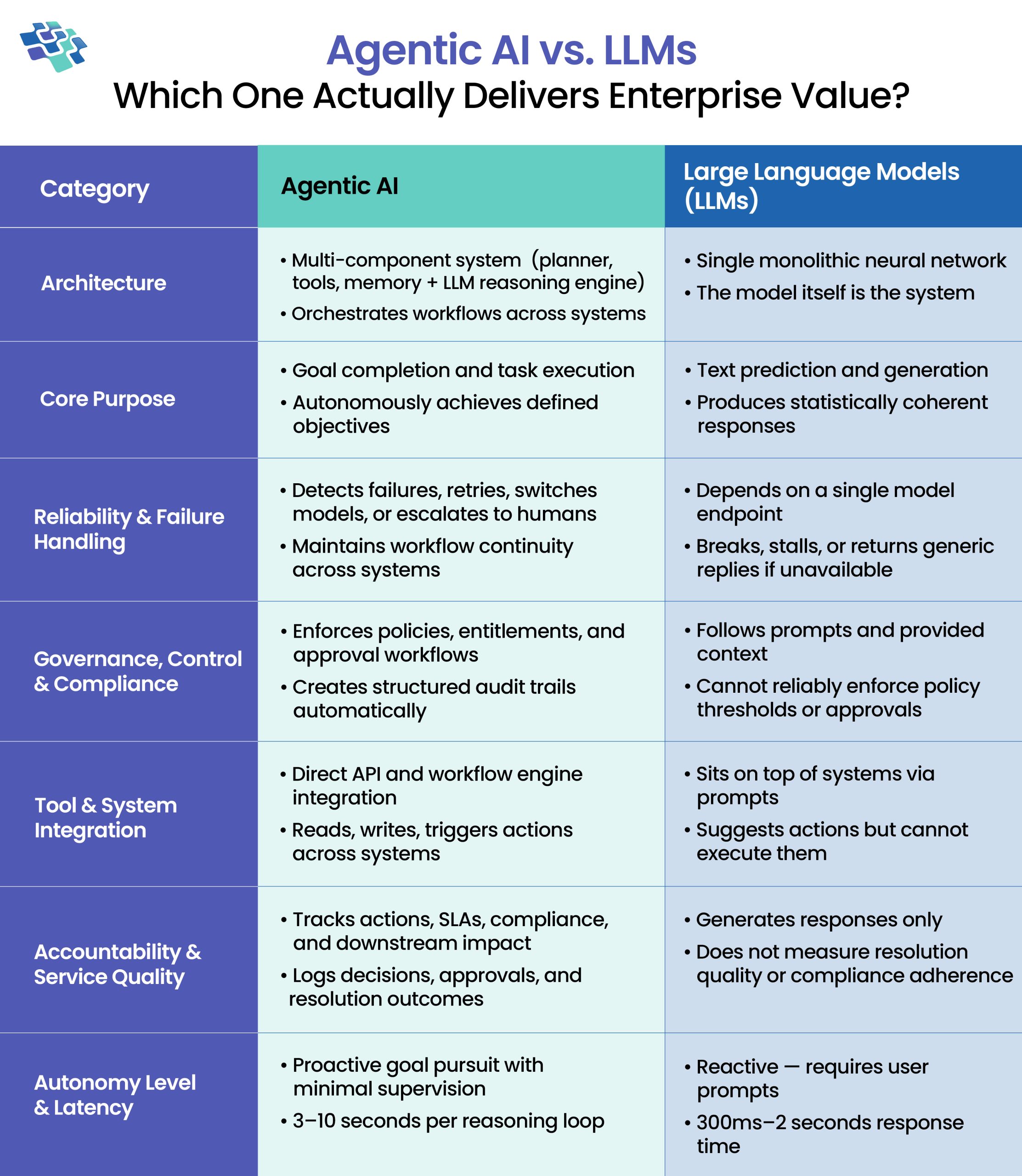
Agentic AI: Agentic AI follows a modular, multi-component architecture where an LLM operates within a broader system. It includes planners, memory modules, and tool integrations that coordinate tasks and actions. This structure enables autonomous workflows, decision-making, and interaction with external systems, making it suitable for complex, multi-step operational processes.
LLMs: LLMs use a single, monolithic neural network architecture where the model itself performs reasoning and generation. The system primarily processes prompts and produces outputs such as text or code. It lacks built-in planning, memory orchestration, or tool execution layers, making it best suited for content generation and conversational tasks.
2. Agentic AI vs LLMs: Core Purpose
Agentic AI: The core purpose of Agentic AI is to achieve defined goals by executing tasks autonomously. It plans actions, interacts with tools and systems, and adapts decisions based on outcomes. Rather than only generating responses, Agentic AI focuses on completing real-world digital objectives through coordinated workflows and continuous task execution.
LLMs: The core purpose of LLMs is to predict and generate coherent text based on input prompts. They analyze patterns in language to produce contextually relevant responses. LLMs primarily support communication, content creation, and reasoning tasks, but they do not inherently execute actions or autonomously complete complex operational goals.
3. Agentic AI vs LLMs: Reliability & Failure Handling
Agentic AI: Agentic AI improves reliability by orchestrating multiple models, APIs, and tools. If one component fails, the system can detect errors, retry requests, switch to backup models, or escalate to a human. This layered approach keeps workflows running and maintains continuity in processes such as customer support, transactions, or operational automation.
LLMs: LLMs typically depend on a single model or endpoint for responses. When the model is slow, unavailable, or times out, the system may stop responding or produce incomplete outputs. Without built-in orchestration or fallback mechanisms, failures often require manual intervention, interrupting conversations or business workflows in mid-process.
4. Agentic AI vs LLMs: Governance, Control & Compliance
Agentic AI: Agentic AI operates with defined policies, roles, and workflow controls. It can enforce limits, apply user entitlements, trigger approvals, and maintain detailed audit trails. This structured governance allows the system to execute actions within policy boundaries while escalating exceptions to supervisors, supporting compliance and operational accountability across automated processes.
LLMs: LLMs primarily follow prompts and contextual instructions rather than strict policy enforcement. While they can reference guidelines, they do not inherently apply approval workflows, limits, or entitlements. As a result, governance and compliance depend heavily on prompt design and external controls, which can lead to inconsistent adherence to business policies.
5. Agentic AI vs LLMs: Tool & System Integration
Agentic AI: Agentic AI integrates directly with enterprise systems through APIs, databases, and workflow engines. It can read and update records, trigger actions, and coordinate tasks across multiple tools. This enables end-to-end automation where processes such as CRM updates, notifications, and ticket resolution occur automatically with full traceability and audit logging.
LLMs: LLMs usually operate as an interface layer above enterprise systems. They analyze prompts and generate suggestions, responses, or drafts, but do not directly execute system actions. As a result, human users or external applications must still update records, trigger workflows, or complete operational tasks in connected business systems.
6. Agentic AI vs LLMs: Accountability & Service Quality
Agentic AI: Agentic AI provides strong accountability by tracking every step, action, and outcome across systems. It records approvals, measures service quality, monitors SLA adherence, and verifies compliance with enterprise policies. This visibility ensures that organizations can audit decisions, evaluate workflow performance, and maintain consistent service standards across automated operations.
LLMs: LLMs focus on generating responses rather than managing outcomes. While they can explain actions or draft communications, they do not track whether issues were resolved, how long processes took, or whether policies were followed. As a result, accountability, service monitoring, and compliance validation must be handled outside the model.
7. Agentic AI vs LLMs: Autonomy Level & Latency
Agentic AI: Agentic AI operates with higher autonomy, proactively pursuing defined goals with minimal supervision. It plans actions, coordinates tools, and iterates through reasoning loops to complete tasks. Because it evaluates steps and system responses during execution, each reasoning cycle typically takes longer, often ranging from about 3 to 10 seconds.
LLMs: LLMs function in a reactive mode and respond only when prompted by a user or application. They generate outputs quickly because they focus on single-pass inference rather than multi-step reasoning loops. As a result, response latency is lower, typically ranging from around 300 milliseconds to about 2 seconds.
LLMs Not Integrating with Enterprise Systems? Build Agentic AI That Connects APIs, Data, And Workflows Seamlessly
From Reactive Systems to Proactive Intelligence: The Future of Agentic AI
The transition from LLMs to Agentic Agents is still a long way off. The following issues are the focus of current research:
- Interpretability: Enhancing the transparency and comprehensibility of AI decision-making to foster confidence and safety in autonomous systems.
- Ethical Considerations: As Agentic Agents gain greater autonomy, inquiries regarding ethics, accountability, and control will have heightened significance. Who bears responsibility when an autonomous agent makes a negative decision? What measures can we implement to ensure the ethical conduct of AI systems?
- Generalization: Making sure that Agentic AI can do a lot of different work in unfamiliar environments without needing a lot of new training or supervision.
Simultaneously, there exist exhilarating prospects. Agentic AI systems have the potential to revolutionize sectors including healthcare (autonomous medical assistants), robotics (self-operating factories or warehouses), and customer service (intelligent virtual agents). Ongoing progress in deep learning, reinforcement learning, and autonomous decision-making will certainly enable Agentic AI to grow into systems capable of authentically emulating human cognition and executing intricate tasks with exceptional efficiency.
Leveraging Retrieval Augmented Generation
Organizations integrate validated institutional knowledge into a large language model with Retrieval Augmented Generation (RAG), which addresses significant issues of AI by sourcing authentic, relevant information from both internal and external environments. In summary, RAG frameworks typically adhere to 3 steps:
- Retrieval: The retrieval model analyzes data to pinpoint the most pertinent documents or text segments associated with the user’s query.
- Augmentation: The initial query and the received data are then merged to produce an augmented prompt that gives the generative model context.
- Generation: Using the enriched prompt, the generative model generates a response that includes necessary information from the retrieved data.
Conclusion
In the debate around Agentic AI vs LLMs, the goal is not to choose one over the other. LLMs continue to power intelligent conversations, content generation, and reasoning, while Agentic AI introduces the ability to plan, act, and execute tasks autonomously across systems. Together, they represent the transition from AI that simply responds to AI that can drive workflows, decisions, and operational efficiency.
For organizations, understanding this distinction is critical. Businesses that combine the strengths of LLMs with agent-based architectures can move beyond isolated automation and build intelligent systems that solve real operational challenges. From automating complex processes to improving customer experiences and enabling faster decision-making, this integrated approach is shaping the next generation of enterprise AI.
As an experienced artificial intelligence development services company, NextGen Invent helps organizations design and deploy scalable AI solutions that combine advanced LLM capabilities with agentic frameworks. Whether the goal is to build intelligent assistants, automate enterprise workflows, or develop fully autonomous AI-driven systems, our team works closely with businesses to translate AI innovation into practical, high-impact solutions.
Frequently Asked Questions About Artificial Intelligence on Robotics

“The real shift in AI is not just making machines smarter but making them capable of acting. While LLMs generate insights and responses, Agentic AI turns intelligence into action, for example, automatically resolving a customer refund by checking policy, updating systems, and notifying the user without human intervention.”
Nitin Kumar

AVP, Data Science
Related Blogs
SLM vs LLM: A Practical Guide for Enterprises Adopting Generative AI
As businesses incorporate AI into their operations, they must choose between SLM vs LLM. Each model type presents unique benefits and compromises regarding cost, computing efficiency, accuracy, and scalability.

Generative AI in Due Diligence: Why Traditional Processes Fail & How to Fix Them
Generative AI in due diligence is emerging as a direct response to this inefficiency. Too often, critical risks, such as hidden liability clauses, surface late in the process, forcing price revisions...
AWS vs Azure Comparison: Which Cloud Platform Is Better for Your Enterprise in 2026
AWS and Azure are the two dominant global cloud service providers, with AWS holding 32% of the market, followed closely by Azure at 23%. In the digital age, these platforms allow businesses...
Stay In the Know
Get Latest updates and industry insights every month.