Multimodal AI Use Cases: How Multimodal Models Work and How Enterprises Are Scaling Generative AI


The multimodal AI industry was estimated to be worth USD 1.2 billion in 2023, and between 2024 and 2032, it is projected to expand at a CAGR of more than 30%. In this blog, we will talk about multimodal AI development and see how big multimodal models work and are trained, as well as how to make them fit your business needs with NextGen Invent.

Too Much Data, Too Little Context? See How Multimodal Models Improve Accuracy Across Real Workflows

“Multimodal Gen AI models can also make technology more accessible to nontechnical users. Because the models can process multisensory inputs, users can interact with them by speaking, gesturing, or using an augmented reality or virtual reality controller. The ease of use also means that more people of varying abilities can reap the benefits that gen AI offers, such as increased productivity.” – McKinsey
What is Multimodal AI and How Multimodal AI Works?
Multimodal AI is a type of AI that uses machine learning to make decisions and can work with various kinds of datasets, or “modalities,” to complete tasks or produce results. Traditional AI systems (unimodal systems) only look at one type of data, like texts, pictures, or audio. Multimodal AI works by combining and processing various kinds of data, like text, images, audio, and sensor data. It does this by following a set of steps:
- Data Collection & Preprocessing: Diverse data types are gathered and preprocessed to ensure compatibility with the AI system. This encompasses the processes of cleaning, normalizing, and extracting pertinent characteristics from each modality.
- Data Fusion: A unified representation is produced by combining the features from each modality through early fusion (integrated at the beginning), late fusion (combined after separate processing), or hybrid fusion (a combination of both).
- Model Training: By learning the connections between the modalities, the machine learning model can develop a thorough comprehension of the data.
- Inference & Decision Making: By combining data from all modalities, the model produces predictions or choices that are more precise and context-aware.
- Output Generation: The system produces multimodal outputs, including creative content, interactive answers, and text descriptions.
Multimodal AI vs Traditional AI: How Multimodal AI Use Cases Differ from Traditional AI Models?
Traditional AI models, also known as unimodal AI, are made to work with just one kind of data input. For example, a computer vision model analyzes only images, but a natural language processing model often deals exclusively with text. This emphasis on a single data stream naturally restricts the context that the AI can comprehend and apply to produce answers or forecasts. Multimodal AI, on the other hand, stands out for its capacity to simultaneously incorporate several types of data. Multimodal AI can comprehend its surroundings far more thoroughly because of the simultaneous processing of multiple modalities, including text, pictures, audio, and video. As a result, these models can produce responses that are more contextually aware in addition to being more accurate.
Unimodal AI models can only produce outputs in the same modality as their input, whereas multimodal AI models can produce outputs in several modalities, providing a more complex and adaptable interaction. Multimodal AI can handle tasks and comprehend situations with a level of nuance that is just unachievable for unimodal systems, which effectively work with a constrained sensory perception, because of its capacity to overcome the constraints of single data kinds.
Key Challenges in Multimodal AI Implementation and How to Address Them
There are many challenges with implementing multimodal AI; there are practical ways to deal with these issues. Let’s take a closer look at the primary issues with multimodal AI and how to solve them.
1. Managing Bias and Ensuring Fair Outcomes
The intricacy of multimodal AI raises the possibility of unfair or discriminatory results across modalities by amplifying biases in training data.
Mitigation Strategy: Create thorough procedures for bias detection and mitigation at every stage of the AI lifecycle. To ensure fair performance across demographics and data kinds, use several datasets, carry out frequent bias audits, and implement fairness metrics.
2. Handling Data Integration and Governance at Scale
Integrating data from many modalities, including text, images, and sensor measurements, is one of the primary challenges in data management and integration. Effective synchronization and analysis of these data kinds is often difficult due to their disparate features and formats.
Mitigation Strategy: A more seamless connection could be ensured by standardizing data formats and using comprehensive preprocessing methods. By utilizing data fusion techniques to integrate multimodal data streams, accurate and consistent analysis can be ensured.
3. Making Sense of Complex Multimodal Inputs
To manage the challenge of interpreting data from several sources, complex algorithms that can understand and correlate a wide variety of data types are required.
Mitigation Strategy: Developing complex machine learning models, such as convolutional neural networks (CNNs) for image data and recurrent neural networks (RNNs) for sequential data, can increase interpretation accuracy.
4. Balancing Performance, Compute Demands, and Scalability
Scalability and real-time processing can be hampered by the substantial computational resources required to handle enormous volumes of multimodal data.
Mitigation Strategy: Combining cloud computing resources with additional technologies, such as GPUs and TPUs, can enhance processing power. Distributed computing frameworks and optimal algorithms are also necessary for scaling processing power to manage multimodal AI applications.
Core Architecture Components of Multimodal AI
To understand how multimodal AI works, we need to look at its three main components:
- Input Module: This component collects several data types, including text, images, audio, video, and sensor readings, and acts as the AI’s data collection gateway. It prepares this varied data for further analysis by preprocessing it.
- Fusion Module: The fusion module serves as the system’s core, adeptly integrating data from many sources through advanced algorithms. It discerns patterns, extracts significant elements, and builds a cohesive representation that encapsulates the core of the multimodal input.
- Output Module: The output module, upon processing, provides findings that may encompass predictions, suggestions, created content, or actionable insights. This output can be sent in multiple media, including text, graphics, audio, or their combinations, contingent upon the application’s needs.
What Enterprises Should Know About Building Multimodal AI Systems
Enterprises can learn how to build multimodal AI development systems by understanding data integration, model architectures, governance requirements, scalability challenges, and real-world multimodal AI use cases that deliver measurable business value.
- Choosing the Right Model Depends on the Use Case: Certain applications necessitate substantial foundational models. Some provide superior performance with compact, domain-specific structures.
- Governance Must Be Built in from the Start: Models that evaluate text, audio, and images bring up issues with compliance and privacy. Logging and access control must be integrated from the beginning. For this reason, a lot of businesses use an AI software development services company with practical experience beyond proof of concept.
- Multimodal Data Preparation Requires Greater Precision: Synchronized data pipelines are necessary for multimodal systems. More than ever, storage design, labeling, and time alignment are important.
- Strong Infrastructure Planning Is Essential for Scale: Multimodal inference may need a lot of resources. Batching, caching, and deployment techniques are key components of cost control.
Business and Operational Benefits of Multimodal AI
Single-modality AI systems cannot match the analytical benefits of multimodal AI, a game-changing breakthrough. These are a few multimodal AI benefits that apply to medication development, healthcare, and research.
1. More Informed and Effective Decision‑Making
Clinicians and data scientists can make better diagnosis and treatment decisions by integrating knowledge from many modalities.
Better health outcomes can result from early diagnosis of treatment hazards and individualized therapy made possible by this.
2. Deeper Understanding through Improved Context
Multimodal AI produces a more comprehensive picture of patient health by connecting disparate data, such as MRI scans, test results, genomes, and clinical notes.
AI models can recognize intricate relationships, such as how genetic mutations or environmental factors affect drug reactions in certain populations, due to their contextual comprehension.
3. Predictive Accuracy
Data integration at the multimodal level improves prediction accuracy. For instance, AI systems can incorporate market patterns, news articles, and financial data to generate more accurate stock estimates during the financial forecasting process.
Businesses can more effectively manage risks and opportunities and gain a better understanding of the data provided. This is beneficial in providing businesses with a competitive edge by providing more precise forecasts.
4. Automation of Complex and Multi‑Step Workflows
Multimodal AI is appropriate for automating tasks that need the understanding of diverse data sources. AI can assist in the diagnostic process by analyzing X-rays, CT scans, and patient data in medical imaging, tasks that demand considerable time and effort from medical professionals.
It can be used, for example, in the retail industry, where AI makes it possible to automate some business processes, such as checking inventory and predicting when replenishment would be required using visual and sensor data.
Understand Why Context Aware AI Performs Better in Complex Enterprise Workflows
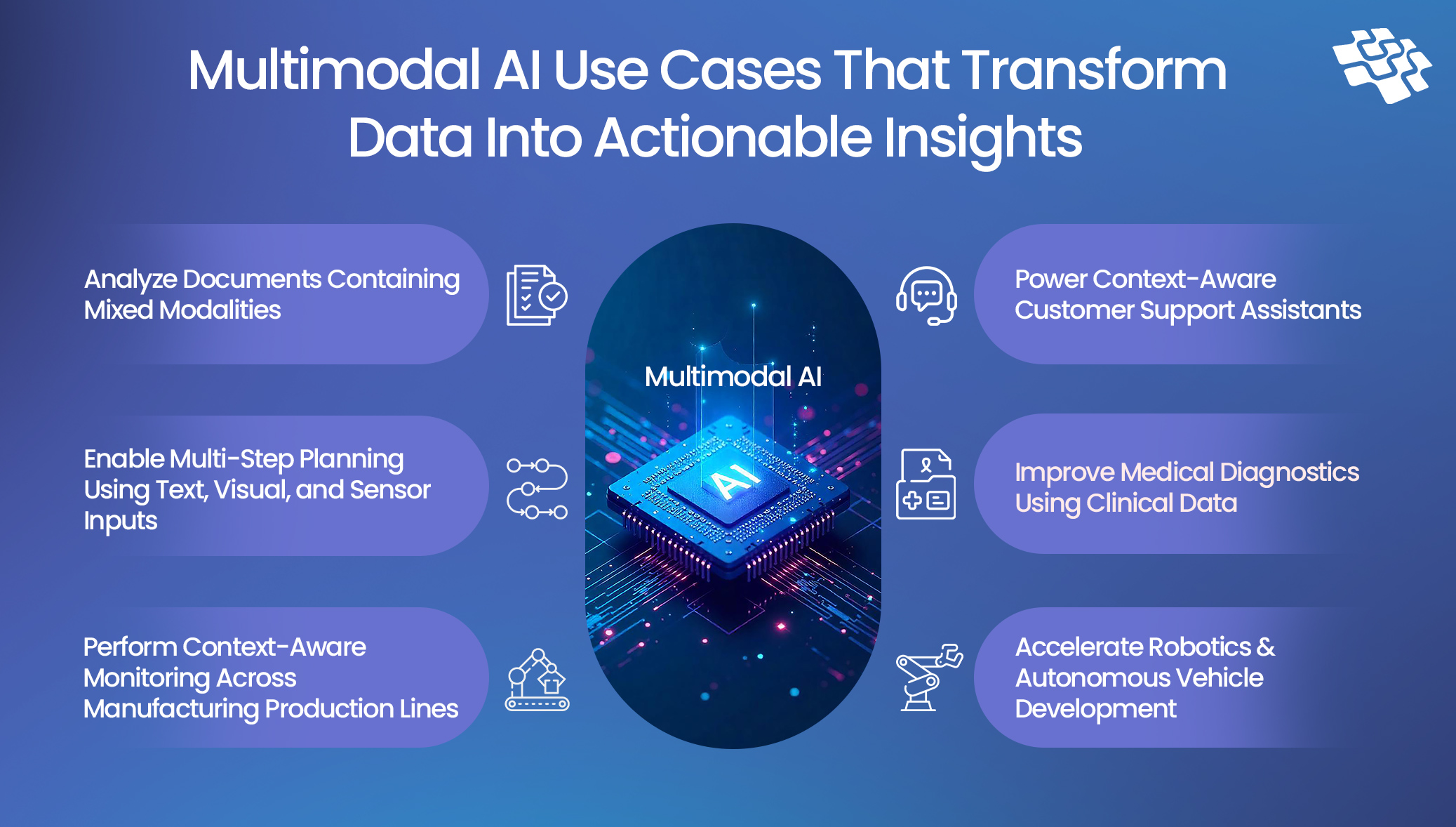
Top 6 Multimodal AI Use Cases That Are Redefining How Businesses Operate
Multimodal generative AI rests on one core belief: understanding is distributed across formats. Text, images, audio, and visuals each reveal different signals, and aligning them enables coherent reasoning and effective multimodal AI use cases that produce outputs suited to real workflows.
 1. Analyze Documents Containing Mixed Modalities
 1. Analyze Documents Containing Mixed Modalities
Most operational documentation is not solely textual. They combine tables, flowcharts, stamps, signatures, and marginal annotations. A multimodal system analyzes each component using the appropriate encoder: image processing for OCR, layout-aware vision for tables, and diagram parsers for schematics.
The outcome is exact extraction and verification: a purchase order number aligned with a manually annotated revision on a design; a tolerance band in a table compared to a symbol in a CAD excerpt; a handwritten exception aligned with policy wording.
This facilitates workflows including:
- Generating product descriptions using product images and structured metadata.
- Deriving structured data from digitized forms and verifying it against ERP records.
2. Enable Multi-Step Planning Using Text, Visual, and Sensor Inputs
Actual work encompasses various systems: specifications in a document, components in a PLM, timelines in a Gantt chart, and issues in an email correspondence. Multimodal agents utilize the shared representation to strategize across various assets, extract constraints from the specifications, align them with CAD annotations, verify inventory status, and produce a staged plan incorporating dependencies and alternatives.
The agent re-plans and emphasizes the precise sources that prompted the change when a constraint changes (e.g., a tolerance tightens or a vendor lapses). The significance of multimodal generation is evident now: the output is not merely a paragraph; it is an updated checklist, a revised BOM remark, or a step-by-step runbook that includes inline citations to the visual or textual evidence that was considered.
3. Perform Context-Aware Monitoring Across Manufacturing Production Lines
The assembly procedures, adherence to safety regulations, occurrence of defects, and field circumstances are all directly captured via video. Multimodal systems reason over sequences rather than individual frames, separate streams into meaningful events, and match them with telemetry and SOPs.
The model can identify a micro-deviation in a motion path in a line inspection scenario, compare it to previous runs where yield decreased, and surface an early warning with the pertinent clip and sensor traces attached. With privacy filters applied on-device, body-cam footage, GPS, and checklists can be used in field operations to produce verifiable records of task accomplishment.
4. Power Context-Aware Customer Support Assistants
A screenshot with a mysterious issue, a brief email exchange, and a call where the user explains the procedures orally could all be examples of a single case. To align these inputs, multimodal generative AI models:
- Segmenting and assigning significance to spoken utterances
- Aligning the problem with an established solution or documentation reference
- Identifying the screenshot’s interface states
The system can subsequently suggest a resolution accompanied by detailed instructions and a confidence score, while associating the call segment and the specific screenshot area utilized for the decision-making process. This transition reallocates agents from manual triage to verification and exception management.
5. Improve Medical Diagnostics Using Clinical Data
The healthcare sector manages a substantial volume of data from several sources, including patient information, laboratory findings, and medical diagnostics. Multimodal AI enhances medical diagnosis by integrating various datasets cohesively, enabling healthcare professionals to get precise diagnoses and formulate appropriate treatment strategies. Its utilizations encompass:
- AI-Powered Assistants
- Intelligent Medical Imaging and Diagnostic Support
- Faster and More Efficient Drug Discovery Pipelines
- Individualized, Data-Driven Treatment Planning
6. Accelerate Robotics & Autonomous Vehicle Development
Multimodal AI is fundamental to robotics development, facilitating robots’ interactions with real-world entities such as humans, vehicles, access points, and structures. It utilizes data from GPS, cameras, and various sensors to assess the surroundings, comprehend them, and engage with them more effectively.
Autonomous vehicles, or self-driving automobiles, employ multimodal AI technology to process input from several sources, including LiDAR, cameras, sensors, and GPS, prior to developing a model of the surroundings. This environmental awareness facilitates secure navigation on the roadway.
Improve Accuracy and Speed by Bringing Context into Every AI‑Driven Decision
How to Evaluate Multimodal AI for Your Business Goals
Before determining whether multimodal AI is appropriate for your customer service setting, there are a few things to think about. You should respond to:
- Do your clients now have difficulties while interacting with your support services? If so, how does that friction appear?
- Are the questions posed by your clients complicated enough to call for more context than text interactions?
- Do you have sufficient reliable data modalities at your disposal to effectively support this kind of approach?
By considering inquiries such as these, you can find chances where more video and audio inputs could start to improve your customer experience by attaining results like quicker call resolutions, more customer happiness, and more productive agents.
Multimodal AI Future Trends of 2026
The goal of multimodal AI in the future is autonomous agent-like behavior and deeper integration across several modalities.
- Edge and On-Device Multimodality: Devices such as the Google Nano series are introducing multimodal functionalities enabling instantaneous image generation and modification without the need on cloud infrastructure.
- Emotionally Intelligent Systems: Cross-modal learning developments will result in cognitive AI helpers that can recognize and react to subtle human emotions, revolutionizing individualized education and mental health wellbeing.
- Physical AI & Robotics: Vision language models will be widely used in robotics, allowing machines to “see,” “hear,” and “feel” their surroundings for accurate task performance in challenging environments.
- Synthetic Data Generation: One of the crucial issues in creating reliable multimodal systems is the rising complexity of synthetic data generation for multimodal training. To reduce reliance on costly real-world data collection while preserving training efficacy, advanced simulation approaches can produce coordinated datasets across several modalities.
Leading Multimodal AI Examples Transforming Real World Applications
Multimodal AI is developing in several domains by merging many forms of data to produce potent and adaptable results. Here are some noteworthy examples:
- GPT-4V(ision): It is an improved version of GPT-4 that can handle both text and images, which means the AI can create visual material.
- DALL-E 3: Based on text prompts, DALL-E 3 is an OpenAI model that makes high-quality images.
- Google’s Multimodal Transformer (MTN): It takes voice, text, and images and puts them together to make video summaries and captions.
- Runway Gen-2: It can make interactive videos with text prompts.
- In-world AI: It can make virtual characters in games and other digital worlds smart and interactive.
Why NextGen Invent is a Strong Partner for Multimodal AI Implementation
NextGen Invent enables enterprises to operationalize AI at scale by embedding intelligence directly into customer interactions, business workflows, and decision-making layers. With deep expertise across data engineering, advanced analytics, and artificial intelligence software development services, our AI data scientists deliver end-to-end AI strategies that move beyond experimentation into production-ready deployment.
The team applies a structured, data-first approach, assessing AI maturity, modernizing data foundations, and designing actionable roadmaps aligned with business KPIs. Leveraging advanced machine learning, Agentic AI architectures, and real-time analytics, NextGen Invent builds solutions that enhance automation, improve operational efficiency, and generate context-aware insights. These capabilities extend across complex enterprise environments, including value-driven multimodal AI use cases that integrate text, voice, visual, and behavioral data for richer intelligence.
By aligning AI initiatives with organizational objectives and measurable outcomes, NextGen Invent helps enterprises modernize analytics, enable self-service intelligence, reduce costs, and accelerate innovation, transforming AI into a durable competitive advantage rather than a standalone technology investment.
Frequently Asked Questions About Multimodal AI Use Cases

“Multimodal AI solves a core enterprise challenge: real decisions don’t live in one data format. By bringing together text, visuals, and signals into a single intelligence layer, organizations improve accuracy, reduce complexity, and make generative AI deliver outcomes that matter in day-to-day operations.”
Ruchi Garg

Chief Digital Officer
Related Blogs

Physical AI Use Cases: Real-World Applications, Examples, and Benefits Transforming Modern Industries
In this blog, we take an in-depth look at the most impactful Physical AI use cases, real world examples, along with its key benefits, and Physical AI trends 2026.

Generative AI in Due Diligence: Why Traditional Processes Fail & How to Fix Them
With Generative AI embedded in due diligence workflows, unstructured documents are analyzed semantically in days rather than weeks.
Agentic AI vs LLMs: What’s the Real Difference That Impacts Your Business?
Agentic AI vs LLMs collectively represent a breakthrough advancement in intelligent automation, radically changing the way robots understand, reason, make decisions, and operate autonomously.
Stay In the Know
Get Latest updates and industry insights every month.