How AI in Computational Biology Accelerates Biological Discovery from Genomic Analysis to Drug Discovery


Despite these limitations, artificial intelligence is upgrading the sphere of computational biology by integrating innovative techniques in genomics, drug discovery, and proteomics. It enhances the speed of DNA sequencing, improves protein function prediction, and enables virtual drug assessment, therapeutic classification, and side effect prediction. Overcoming present limitations demands improved data integration, clearer models, and interdisciplinary collaboration. AI can help translate complex biological data into meaningful discoveries and advancements in precision medicine.
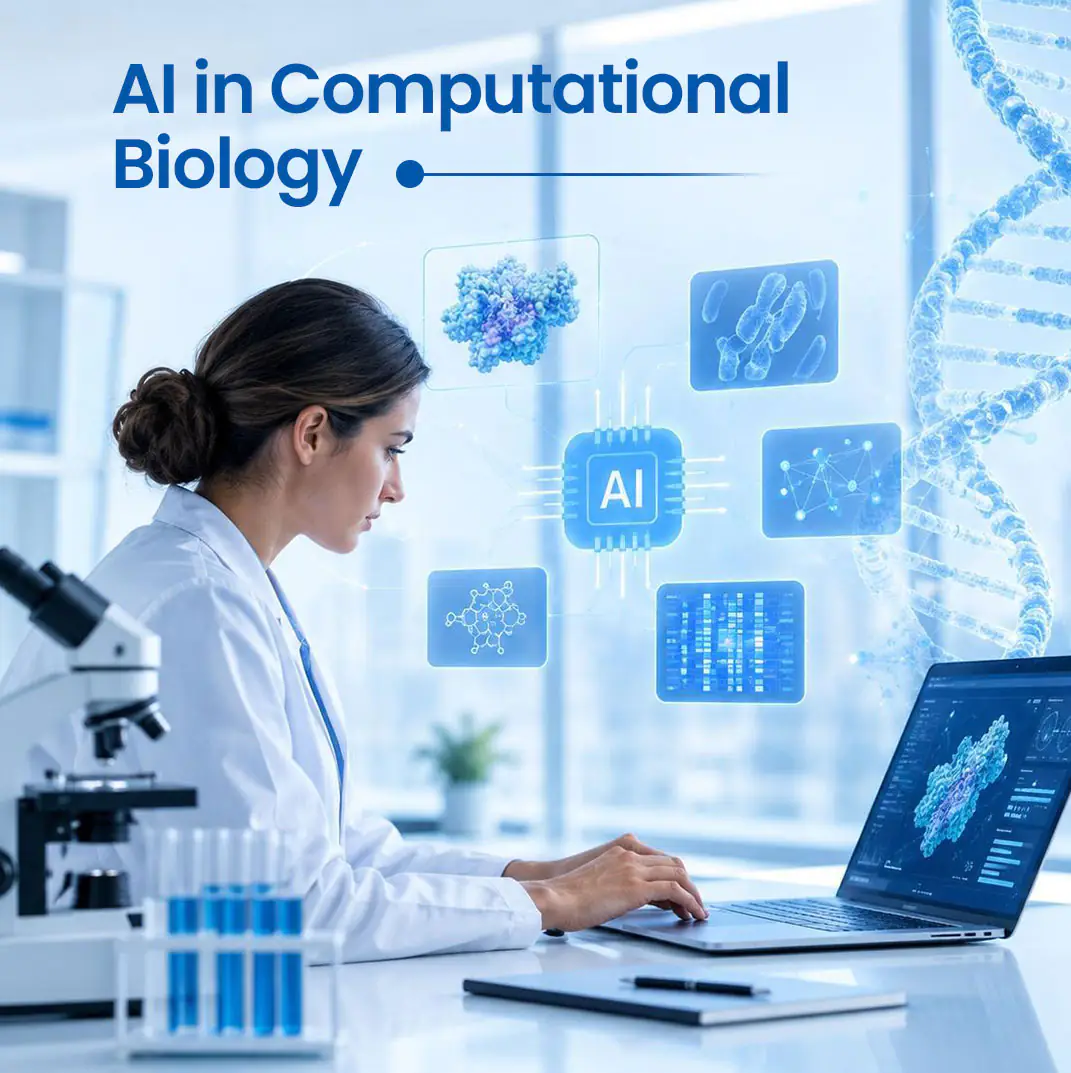
Researchers Are Using AI To Analyze Millions of Biological Data Points in Less Time. Are Your Existing Processes Keeping Pace?

“Various life science research companies and technological organizations are actively adopting and integrating AI in their workflows. AI can be applied in gene therapy for designing vectors and modelling gene delivery methods, for developing personalized medicine strategies, protein identification, automating biological image analysis in microscopy and medical imaging, and enhancing gene-editing technologies such as CRISPR.” – Precedence Research
What Is AI in Computational Biology?
Computational biology examines complicated living systems, especially in genomics and protein structure prediction, by fusing innovative computation with biological studies. A fundamental tenet of molecular biology is the transfer of genetic information from DNA to the functional machinery of proteins: DNA is transcribed into RNA, which is subsequently translated into protein sequences.
AI applications in computational biology augment:
- The prediction of gene functions,
- the identification of mutations responsible for diseases,
- and the correct modeling of protein structures.
These are highlighted by innovations such as AlphaFold for protein folding and DeepBind for the detection of DNA regulatory elements. By associating genomic data with protein roles, AI speeds up the progression from DNA sequences to functional compounds, supporting pharmaceutical innovation and tailored therapy.
The AI computational framework allows for the exploration of this biological route, promoting a thorough understanding of biological systems from the genetic blueprint to the functional molecular components.
How Does Computational Biology Work?
Computational biology employs computers and stored data to comprehend biological systems and mechanisms. It helps scientists replicate, simulate, and forecast a wide range of biological systems, from complex organ interactions to more basic cell functions.
- For instance, despite humans being made up of tens of thousands of genes, researchers could only develop new medications and scientific advancements using fragments of human DNA for years. By mapping DNA fragments into a complete human genome for the first time, the Human Genome Project employed computational biology to solve this issue. This allowed researchers to identify the relationships between genes and diseases and use that information to develop treatments.
- Another computational biology method is virtual screening, which looks through drug chemical databases and virtually analyzes thousands of them to identify potential therapeutic candidates. This method reduces the number of substances that a researcher must examine one at a time in a lab.
These strategies enhance scientific discovery and medical therapy by devising care plans for hematological diseases, neurological disorders, and other medical conditions.
What Role Does AI Play in Computational Drug Discovery?
Drug discovery has historically been a costly and time-consuming procedure. However, this approach is becoming increasingly effective with the development of AI in computational drug discovery.
In computational drug discovery, AI models can mimic a molecule’s behavior in the human body after determining its formula. It can discover the most promising candidates and filter out those with poor prospects before they are put through any physical testing by analyzing billions of potential chemical configurations.
AI enables researchers to evaluate millions of potential drug candidates digitally and narrow them down to a select group with the highest likelihood of success. These candidates then undergo experimental validation in biological systems, with only a handful progressing to subsequent stages of drug discovery and development.
Following the identification of prospective compounds, it is crucial to conduct clinical trials to assess their effectiveness and safety, potentially incurring costs of over $70 million. Despite this, the procedure is essential for introducing new drugs to the market, providing life-saving solutions and substantial profits for those who prevail.
Check Our Case Study: Clinical Trial Supply Chain Intelligence to Improve Forecasting, Drug Availability & Operational Efficiency
Why Biopharma Organizations Need a Sub-Process View of AI Opportunities: AI Framework in Genomics
The artificial intelligence framework in genomics includes data collection, quality assessment, alignment, multi-modal synthesis, and model-based inference. Standardized and privacy-protected datasets are examined through machine learning and deep learning models to identify trends, categorize patients, and deduce clinically significant biomarkers.
After preparation, the multi-modal datasets are analyzed with deep learning models to recognize biological patterns, forecast disease-related risk, and classify patient subtypes.
Standardized measurements gauge model success, while explainable AI techniques like SHAP (SHapley Additive exPlanations), LIME (Local Interpretable Model-agnostic Explanations), and Integrated Gradients enhance interpretability of genetic elements.
The final stage applies these insights to personalized medicine, enabling treatment strategies tailored to an individual’s genetic and phenotypic characteristics. AI helps integrate and analyze complex biological data, transforming molecular insights into actionable clinical recommendations that can improve diagnostic accuracy and treatment outcomes.
Computational Biology vs Bioinformatics
Despite their close relationship, computational biology and bioinformatics differ significantly from each other.
- Computational biology entails the development and utilization of mathematical models and computer simulations to investigate complex biological systems and processes.
- AI in bioinformatics is engaged in the formulation and application of computational strategies for the assessment and understanding of large-scale biological datasets.
Another approach to understanding the distinction between the two areas is to reflect on what they focus on.
- Computational biology emphasizes the development of models and simulations.
- Bioinformatics focuses on data analysis.
Another area of computational biology vs. bioinformatics is their core application.
- AI applications in computational biology include protein structure prediction, systems biology modelling, and molecular dynamics simulation.
- AI in bioinformatics primarily focuses on genome assembly, variant calling, database administration, and sequence alignment. It is linked to software development, as most everyday tasks include scripting, pipeline maintenance, and the development of tools capable of processing thousands of samples.
Core AI Technologies Used in Computational Biology
- Graph-Based Models: These help researchers analyze complex biological relationships, including protein interactions, metabolic pathways, and drug-target connections, to uncover insights that support biological research and drug discovery.
- Machine Learning: AI-driven machine learning models help researchers classify gene expression patterns, predict the impact of genetic variants, and identify protein functions from complex biological data.
- Deep Learning: These models, such as convolutional neural networks (CNNs) and transformers, help researchers analyze genomic data, predict protein structures, and identify important biological patterns within DNA sequences.
Further Read: The Ultimate Comparison of Machine Learning vs Deep Learning
Benefits of AI in Computational Biology
AI helps researchers make sense of massive volumes of genomic, proteomic, and molecular data that would be challenging to analyze manually. By identifying disease-related patterns, predicting protein structures, accelerating drug discovery, and integrating data from multiple biological sources, artificial intelligence enables faster and more informed scientific decision-making while reducing the time required to move from data analysis to biological discovery.
1. Faster Biological Analysis
AI accelerates biological analysis by analyzing massive amounts of genetic data much faster than traditional methods. Current AI models can examine millions of DNA sequences, recognize biological patterns, anticipate gene activity, and evaluate disease risk, enabling researchers to produce insights in a fraction of the time of traditional methods.
With biological datasets growing larger and more complex, AI is helping researchers speed up the transition from data collection to discovery. It is also enabling more efficient research, biomarker identification, and therapy development.
2. Improved Prediction Accuracy
Artificial intelligence can improve the prediction of biological data that are hard to identify by standard computing technologies. But more advanced models can tell you what a gene does, analyze DNA sequences, understand how cells operate from RNA data, and forecast how proteins will interact with drugs.
These characteristics help researchers get more insights, identify interesting candidates, and make better decisions during the research and drug discovery process.
3. Supports Personalized Medicine
AI in drug discovery enables personalized gene expression patterns to deliver insights that could impact disease risk, diagnosis, and treatment options. It allows physicians to better understand disease processes and design treatments that are personalized to the individual characteristics of the patient.
Artificial intelligence in computational biology provides a more tailored approach to healthcare by identifying individual biological characteristics and incorporating numerous data types from patients.
High-Volume Biological Data Requires More Than Analytics. Build An AI Ecosystem Designed for Research Impact
AI Applications in Computational Biology: Where Artificial Intelligence Delivers the Most Impact
Wondering where AI is in computational biology today? AI is aiding researchers in analyzing genetic data, predicting protein structures, uncovering novel medication candidates, and much more to address difficult biological problems faster and more efficiently. In this section, we’ll look at six of the most important AI applications in computational biology and how they’re driving biological research and innovation forward.
 1. AI in Genomics and Sequence Analysis
 1. AI in Genomics and Sequence Analysis
A significant accomplishment that set the stage for genetic information was the sequencing of the human genome. However, a major barrier for researchers is the enormous amount of genetic data generated. AI has been crucial in understanding the complexities of genetic data. It helps:
- Identify possible regulatory elements,
- forecast gene functions, and
- discover genetic variations linked to diseases by using pattern recognition and predictive modeling.
Deep learning algorithms have proven to be effective at identifying significant patterns in genetic sequences. By identifying minute connections between genes, these models open the door to a more thorough comprehension of the genetic underpinnings of numerous disorders. AI in genomic data processing not only speeds up research but also creates opportunities for personalized medicine. It identifies unique genetic variations that affect disease susceptibility and treatment response.
Check Our Case Study: First-of-its-Kind Pharmacogenomics Ecosystem with an AI & Product Strategy
2. Protein Structure Prediction and Molecular Interactions
Determining the roles and interactions of proteins requires an understanding of their 3D structure. AI models can predict the structure of proteins from their amino acid sequence, allowing scientists to understand protein function better, as well as the causes of disease and potential therapeutic targets.
Precise protein structure prediction is essential because it enables scientists to pinpoint possible therapeutic targets and create more precise treatments. AI in protein structure prediction has the potential to completely transform medication design by enabling the development of more focused and efficient therapies.
3. Biological and Biomedical Image Analysis
Because of developments in imaging technologies, researchers now have unparalleled access to biological images, from cellular microscopy to medical imaging. Computer vision is helping to automate the examination of these images. Convolutional Neural Networks (CNNs) are more accurate than traditional methods at identifying patterns, spotting abnormalities, and categorizing cellular structures.
In addition to speeding up research, biological image analysis automation improves the consistency of results. AI-powered image analysis technologies have the potential to transform diagnostics by helping to find signs of disease and developing new treatment approaches.
4. Personalizing Treatments and Optimizing Therapeutic Decisions
With the use of AI, the idea of personalized medicine in which therapies are tailored to each patient’s unique profile becomes more viable. Machine learning algorithms can forecast individual reactions to treatments by examining various datasets, such as genomic data, health records, and lifestyle factors. This makes it possible to optimize therapeutic approaches, reduce side effects, and boost treatment effectiveness.
An artificial intelligence-based clinical decision support system can enhance patient outcomes. Healthcare practitioners can make better decisions and provide treatments that are both successful and personalized to each patient’s unique characteristics by using AI to examine individual patient data.
5. Drug Target Identification and Drug Discovery
More than 1060 molecules make up the enormous chemical space, which encourages the synthesis of numerous drug compounds. However, the drug development process is constrained by a lack of advanced technologies, which makes it a costly and time-consuming operation that AI can help with. AI can identify:
- Hit and lead compounds,
- validate the drug target more quickly, and
- optimize the drug structure design.
Computational models based on the quantitative structure-activity relationship (QSAR) can rapidly predict chemicals or basic physicochemical parameters like log P or log D.
When compared to traditional machine learning techniques, deep learning models demonstrated notable prediction potential for fifteen drug candidate absorption, distribution, metabolism, excretion, and toxicity data sets.
6. Novel Proteins and Engineering Enzymes
AI helps researchers design new proteins and develop enzymes with specific functions by predicting how changes in amino acid sequences can affect their structure and behavior.
Instead of relying solely on trial-and-error experimentation, researchers can use AI to identify:
- Promising protein designs,
- optimizing enzyme performance, and
- exploring a wider range of biological possibilities.
This helps accelerate research in drug discovery, biotechnology, and synthetic biology while reducing the time required to develop proteins for targeted applications.
Unlock Greater Value from Genomics, Proteomics, Multi-Omics, And Drug Discovery Data with AI Solutions Built for Life Sciences Innovation
Proven Strategies for Implementing AI in Genomics: Step-by-Step Implementation Roadmap
- Step 1 – Define Objectives: Firstly, clearly state the objectives of using AI in a genomics project, such as speeding up drug discovery or increasing diagnostic precision.
- Step 2 – Data Collection: Once the objective is clearly defined, collect dependable sources of high-quality genetic data.
- Step 3 – Choose the Right Tools & Model Training: After successfully collecting data, choose AI software and algorithms based on your requirements. Then use labeled genomic datasets to train your AI algorithms.
- Step 4 – Validation and Testing: To verify accuracy, test the model’s performance on different datasets.
- Step 5 – Deployment: Make sure the AI model conforms to regulatory standards when you incorporate it into your process.
- Step 6 – Monitoring & Optimization: The last step is to consistently analyze the model’s performance and update it, as necessary.
Limitations & Challenges of AI in Computational Biology
1. Data Privacy and Security
AI systems require enormous volumes of data to work well. Sensitive patient data, such as genetic information, medical histories, and clinical records, are frequently included in the healthcare industry. Recent breaches in large hospital systems have brought the necessity for strong security measures, as AI-driven healthcare solutions are vulnerable to attacks. For example, an OpenAI-powered AI agent reportedly bypassed security controls on Australia’s Medicare statistics portal while autonomously searching for healthcare spending data, gaining unauthorized access to government data.
To solve these ethical issues and preserve patient trust, AI systems must follow data protection laws including HIPAA (USA), GDPR (EU), and PIPEDA (Canada).
2. Bias in AI Models
AI models trained on biased or non-representative datasets can lead to partial outcomes, creating gaps in diagnosis, treatment, and drug discovery. Systemic inequities must be addressed when integrating AI into healthcare. Recent developments show how public-private collaborations and inclusive datasets might improve health equity by lowering algorithmic bias.
It is necessary to train AI models on representative and diverse datasets to reduce these issues. To find and fix biases before they cause harm, regular audits and algorithmic openness are also required.
3. Transparency and the Black Box Problem
Many AI models, particularly deep learning models, function as “black boxes,” providing limited data about how they make decisions.
Concerns with accountability and confidence in clinical diagnostics are raised by the lack of interpretability.
4. Data Heterogeneity
AI models lose accuracy and generalizability due to biases introduced by variations in data sources, formats, and quality.
Inconsistent data can impede the model’s applicability in various clinical situations and result in inaccurate diagnoses.
5. Sensitivity-Specificity Trade-off
It’s difficult to strike a balance between sensitivity and specificity; improving one frequently affects the other, particularly with rare diseases because there isn’t enough training data.
An increase in sensitivity can result in more false positives, while an increase in specificity could fail to detect actual infections, impacting the reliability of diagnostics.
Artificial Intelligence and Bioinformatics: How AI Helps Analyze Biological Data
AI in bioinformatics functions as a key impetus in biological data analysis, with the availability of critical computational infrastructure and analytical resources. It creates large-scale databases derived from biological research, including genomes, proteomics, and metabolomics.
Biological data is often complex, high-dimensional, and difficult to analyze using traditional methods. AI helps researchers identify patterns, predict biological structures, and uncover insights from large datasets, turning raw biological information into actionable knowledge that accelerates scientific discovery.
Additionally, researchers can now quickly discover homologous genes and comprehend evolutionary connections because of AI techniques that increase the speed and accuracy of sequence alignment and analysis.
Future Trends of AI in Computational Biology
- Multi-Omics Analysis: AI can make it easier to integrate data from different “omics” domains, including proteomics, metabolomics, transcriptomics, and genomics. A more thorough understanding of disease causes and possible therapeutic targets is provided by this multi-omics study.
- AI in Rare Disease Diagnosis: Diagnosing rare diseases can be challenging because they at times entail complicated genetic differences. Rare genetic conditions can be diagnosed much more quickly and accurately because of AI’s capacity to evaluate and interpret genomic variants.
- Integration with EHRs: Artificial intelligence-based genomics, when integrated with EHRs, can create a thorough patient profile that includes genomic data, medical history, and lifestyle information. This comprehensive method makes personalized and effective treatment plans possible.
Conclusion
If you’re working with complex biological data, the real value of AI lies in turning that complexity into insights researchers and clinicians can act on. From genomics and protein structure prediction to drug discovery and personalized medicine, AI helps accelerate analysis, improve prediction accuracy, and identify opportunities that may otherwise remain hidden.
However, realizing these benefits requires high-quality data, transparent models, rigorous validation, and close collaboration between computational scientists, biologists, and clinicians. When these foundations are in place, artificial intelligence in computational biology can shorten the path from biological data to meaningful scientific discoveries, targeted therapies, and improved patient outcomes.
Organizations looking to operationalize these capabilities need more than individual AI tools. At NextGen Invent, we help research and healthcare organizations build scalable data, AI, and analytics ecosystems that support innovation across the life sciences value chain. Our expertise spans advanced analytics, genomics, and intelligent healthcare solutions. It also includes the development of an AI-powered medical laboratory information management system that helps streamline laboratory workflows, improve data accessibility, and support faster, data-driven decision-making.
Looking to accelerate biological discovery, optimize research workflows, and unlock greater value from your biological data with AI? Contact NextGen Invent to explore how our AI and data scientists can support your research and innovation goals.
Frequently Asked Questions About AI in Computational Biology

“The challenge is no longer generating biological data. It is knowing which signals matter, which hypotheses are worth pursuing, and where the next breakthrough may emerge. AI is helping researchers cut through that complexity and focus their efforts where they can create the greatest impact.”
Michael Kaminaka

Chief Growth Officer
Related Blogs

AI Use Cases in Biopharma: Identifying High-Value Opportunities Across the Value Chain
AI in biopharma has gone from luxury to necessity, spurred by unsustainable costs and failure rates. The traditional R&D for any new drug can cost as much as 1 to 2.5 billion dollars and can take anywhere between 10 to 14 years.

How Data Analytics in Pharma is Transforming Drug Discovery, Clinical Trials, and Personalized Medicine
Did you know that 30% of the global data volume comes from the healthcare sector? It is difficult to have an ideal analytics operational model with a large quantity of data.

How AI Predictive Diagnosis Helps Detect Diseases Earlier and Improve Clinical Decision-Making
Clinicians still have too much administrative burden. There are still many important insights buried in fragmented systems. Manual reviews are still leading to diagnostic delays.
Stay In the Know
Get Latest updates and industry insights every month.