Agentic Operating System: How Enterprises Eliminate AI Chaos and Scale Autonomous Workflows


This article delves into the true nature of an agentic operating system, its functionality across decision and execution layers, and the reasons it is becoming increasingly important for enterprises that are seeking to scale automation with control, security, and measurable ROI.
Explore A Practical 30-60-90 Day Roadmap for Enterprise Agentic OS Adoption at Scale

“Success with agentic AI depends on a data architecture that can support increasing levels of autonomy, coordination, and real-time decision-making. This often looks like modular, interoperable frameworks that give agents reliable access to the data they need to operate safely.”– McKinsey
What is an Agentic Operating System (AOS) in Simple Terms
An agentic operating system is not a software application that you install. It is a structured directory comprising specific files that outline the cognitive processes, actions, and development of your AI agents. Consider it this way: a conventional operating system governs hardware resources to facilitate the execution of programs. An agentic operating system governs context to help the functioning of AI agents. It informs agents of their identity, knowledge, procedural guidelines, and acquired insights.
This is the useful layer behind agentic AI, if you’ve been wondering what it is and why it matters. Agentic AI can plan, execute sequences of actions, and adapt, but only if it has a location to store and retrieve the context necessary for those activities. The essential understanding is that AI agents don’t forget because they are naive. They forget due to the absence of a consistent repository for their acquired knowledge. An agentic operating system addresses that issue.
An agentic OS is not any of the following:
- A fine-tuned standalone model
- A knowledge base repeatedly injected into context
- A plugin or add-on layered onto an existing tool
It is an organized workstation that agents utilize for reading, writing, and continuous development.
Why Does the Agentic Operating System (AOS) Matter in 2026?
Three elements have converged simultaneously:
- AI models are significantly more advanced; they can plan, reason, and manage intricate multi-step processes.
- Agents can now consistently call APIs, create and execute code, query databases, and engage with actual systems because of advanced tool use.
- There are orchestration frameworks available; platforms such as Databricks, Microsoft Fabric, and Claude’s Agent SDK now natively handle multi-agent systems.
Agentic OS is therefore no longer a research subject. It is something that companies can use now.
What Makes a System Agentic?
Let us analyze it for enhanced comprehension:
- Agents: These are AI-powered autonomous workers. They do all you require, including calling leads, sending emails, updating CRMs, and qualifying prospects.
- Operating System: This software layer instructs agents on what, when, and why to accomplish certain tasks. It oversees exceptions, priorities, and sequences.
Rather than simply executing fixed scripts or workflows, an agentic OS enables agents to:
- Maintain awareness of context while storing and recalling relevant information over time
- Adjust goals and task importance dynamically as conditions change
- Work in coordination with other agents to achieve shared outcomes
- Evolve capabilities through ongoing learning and iterative improvement
Can an Agentic Operating System Replace Traditional Automation?
We should look at these layers side by side because search terms like “AI OS 2026” and “agentic OS” are becoming more popular for a reason:
Primary Focus
- Traditional AI platforms are primarily centered on models and APIs. Their main purpose is to enable organizations to build, deploy, and access artificial intelligence capabilities through defined interfaces rather than through system‑wide intelligence coordination.
- An agentic operating system is fundamentally focused on orchestration, context, and governance. Instead of emphasizing individual models, it acts as a coordinating layer that manages how intelligence operates across systems, processes, and agents.
Core Value
- From a value standpoint, traditional AI platforms focus on model deployment and serving. They are well‑suited for teams that want to train, test, and operationalize individual models efficiently without extending intelligence across multiple systems or workflows.
- The core value of an agentic operating system lies in cross‑system intelligence coordination. It enables multiple AI components or agents to work together, share context, and make aligned decisions rather than operating in isolation.
Governance & Security
- In terms of governance and security, traditional AI platforms rely on model‑centric controls. Oversight is applied at the level of individual models, rather than across the broader lifecycle of decisions, interactions, or policies.
- An agentic operating system delivers full‑stack governance and policy enforcement. Controls are applied not just at the model level, but across workflows, agent behavior, and decision execution.
AI Operating System vs Agentic Platforms vs Cloud — Side‑by‑Side Comparison Table
| Aspect | AI OS | Agentic Platforms | Coud |
| Primary Role | Coordinates intelligence, data context, and enterprise AI workflows | Carries out autonomous actions through AI agents | Delivers scalable computing and storage infrastructure |
| Core Value | Enables unified intelligence orchestration across systems | Focuses on independent task execution and autonomy | Acts as the foundational infrastructure layer |
| Scope | Adds intelligence layers on top of existing infrastructure | Narrowly centered on autonomous AI agents | Broad coverage supporting all application types |
| Example | A purpose‑built AI operating system layer | Platforms designed for agent‑driven workflows | Services such as AWS, Azure, and Google Cloud Platform |
What Are the Five Core Layers of an Agentic Operating System
When you know what skills you need, you need five layers to make them work together as a system: memory, orchestration, brand context, tools and integration, and AI workflows. If you don’t have all five, you have a bunch of tools and not an OS.
1. Memory Layer
What distinguishes a functional system from a useless one is memory. You must reiterate the project’s state, the client, the brand voice, and the limitations. An agentic OS employs two types of memory:
- Long-Term Memory: Stores information about the company, customers, procedures, and preferences. This is consistent among agents and sessions.
- Working Memory: This is the task’s current context window. What has been decided, what is still pending, and how the output appears right now.
One of the most frequent failure points in real-world deployments is the AI agent memory wall. An agent loses track of its activities when it completes a lengthy task and uses up all its context window. Agents can read from and write to external memory stores at any stage of a workflow in a well-designed agentic operating system.
2. Orchestration Layer
Who gives an agent a task? It’s orchestration. It functions as the agentic OS’s traffic controller. When there is no orchestration, there is an agent sprawl, which means that dozens of agents are working alone, doing the same work twice, or clashing with each other. No one has a clear picture of these agents.
Task routing, scheduling, and handoffs between agents are all taken care of by agent orchestration. It decides whether a task should be given to a single specialized agent to complete or split up into smaller tasks that can be done by different agents. It keeps an eye out for problems and chooses what to do when something does go wrong.
3. Brand Context Layer
This is the “knowledge layer” of the system, a structured document (or collection of documents) that each skill reads before executing. It provides answers to the queries that would otherwise necessitate briefing the agent by a human:
- What are the company’s activities, and who are its clients?
- Which terms or phrases should we refrain from using?
- What are the current priorities, initiatives, or product developments?
In the absence of a shared brand context, each skill functions independently. A shared brand context is a Markdown file or a structured data repository located at the system’s apex. Each skill incorporates it as a component of its input.
4. Tools and Integrations Layer
An agentic operating system must integrate with the software utilized by your organization, including CRMs, project management applications, communication platforms, databases, and file systems. Most enterprises utilize a combination of SaaS products that were not intended for AI accessibility. The integration layer issue, linking X agents to Y tools without creating X×Y bespoke integrations, is a fundamental architectural challenge in developing an agentic operating system.
The effective solution is to implement a cohesive integration layer that divides tool connections into standardized APIs accessible to any agent.
5. AI Workflows Layer
Individual agents manage distinct tasks. Workflows integrate tasks into business processes. A content production workflow may consist of the following steps: conduct research on a topic → create an outline → prepare a draft → implement brand guidelines → perform a quality assessment → submit for approval. Each phase is managed by a distinct agent or skill. The workflow interlinks them, transferring outputs sequentially, diverging upon fulfillment of requirements, and iterating when modifications are required.
Agentic workflows incorporating conditional logic, loops, and branching facilitate this capability. It is a process that adjusts according to its interactions.
Learn Why Agentic OS Matters for Scaling AI Automation Securely Across Complex Enterprises Globally Today
Top Enterprise Use Cases Where an Agentic Operating System Delivers Business Value
For enterprise leaders, the pivotal question is not if an agentic operating system will integrate into your technological stack; this is currently occurring. The question under consideration pertains to your intention to embrace them via managed, governed platforms. The AI workflows listed below show where enterprises are using agentic OS deployments in 2026.
 1. DevOps Pipeline Intelligence & Contract Management
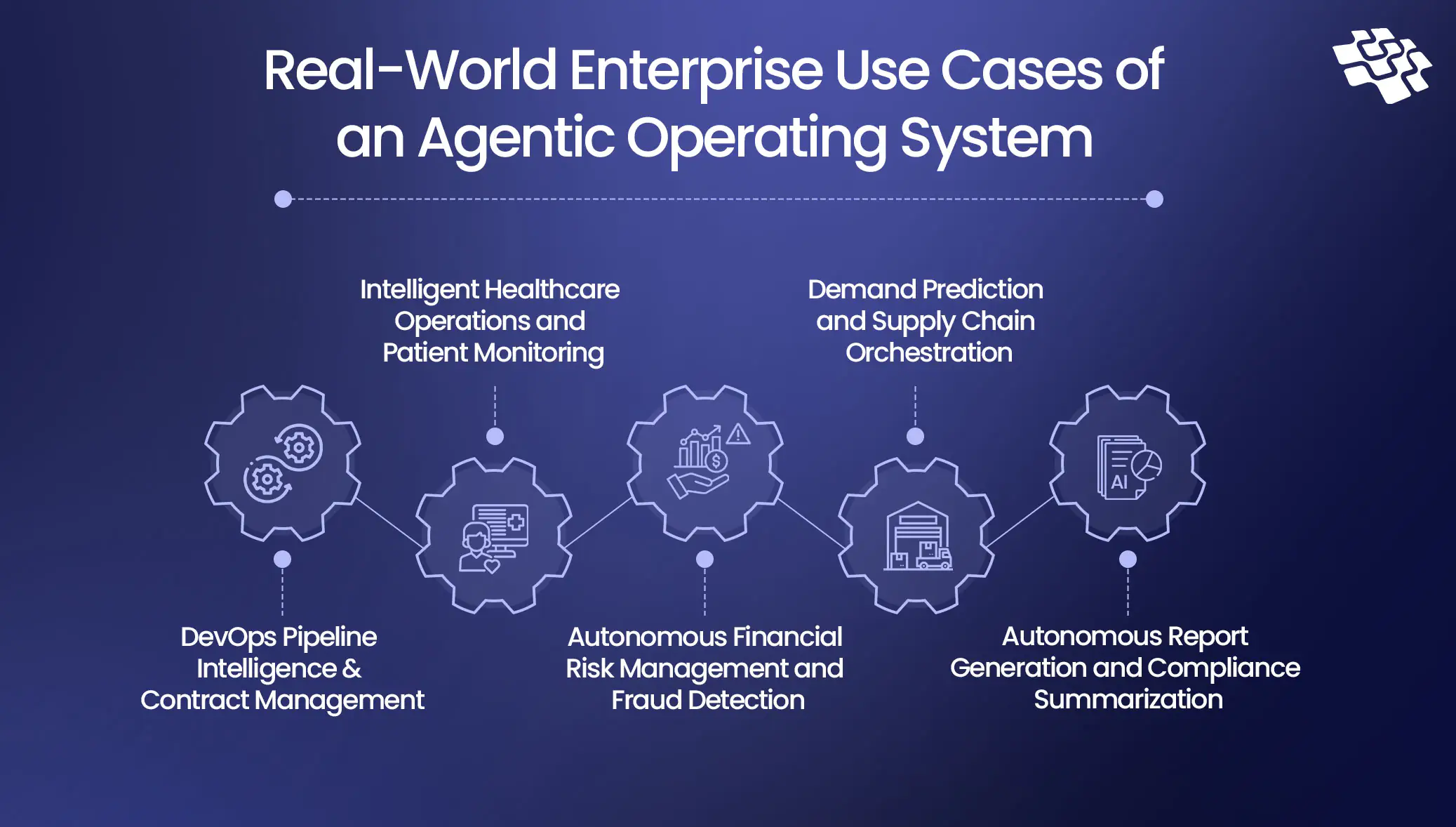 1. DevOps Pipeline Intelligence & Contract Management
Agentic OS continuously monitors CI/CD pipelines. When a build fails at 3 in the morning, the agentic operating system identifies the owner, links the problem with recent commits, determines whether the test has previously failed, and provides a contextual triage on Slack along with a suggested solution. An intelligent synopsis that keeps track of previous events.
When handling hundreds of contracts, procurement teams forget about SLA deadlines and renewals. A scheduled agent monitors SLA infractions, monitors due dates, marks renewals that are 60 days away, and alerts the relevant stakeholder. High-value, low-risk, ideal for an agent that retains context over several months.
2. Intelligent Healthcare Operations and Patient Monitoring
These technologies can notify care teams and save lives by analyzing patient data, monitoring situations in real-time, and offering timely intervention. From basic monitoring to proactive care orchestration, an agentic operating system for healthcare has advanced. The AI healthcare operating system now manages all patient care workflows:
- Keep an eye on patient data and vital signs from various sources
- Manage billing procedures and insurance pre-authorizations
- Anticipate health decline before symptoms occur
- Plan interventions and manage care teams
Life sciences are among the first industries to experience tangible advantages from agentic AI. Using agentic processes, a leading hospital network reduced patient readmission rates by 40% and the average stay length by 2.3 days. When the technology proactively identifies patients who are at risk, it initiates preventive care treatments automatically.
3. Autonomous Financial Risk Management and Fraud Detection
Insurance companies automate about 91% of individual automotive claims by integrating an agentic OS into their claim workflow. Financial services have adopted agentic workflows to handle complex risk assessment and fraud detection in real-time. Financial AI agents are now in charge of extensive risk and security processes:
- Track transactions in real time across international networks
- Identify and investigate questionable trends across a variety of data sources
- Modify insurance rates in response to current risk assessments
- Oversee regulatory compliance in several jurisdictions
A major international bank that handles over 100 million transactions every day for fraud detection developed agentic fraud detection protocols. The approach decreases false positives by 70% and detects 94% of fraudulent activity, much of which would have gone unnoticed by traditional techniques. Loan applications now just take minutes to process instead of days.
4. Demand Prediction and Supply Chain Orchestration
Since AI-powered supply chain managers can rapidly modify inventory to match changes in real-time demand, they are a significant improvement over traditional supply chain management systems. Logistics workflows are managed by supply chain AI agents:
- Reroute shipments automatically and modify inventory levels in response to current circumstances
- Manage procurement choices independently and engage in supplier negotiations
- Improve warehouse operations
- Forecast changes in demand based on social, weather, and market conditions
Smart inventory tracking predicts stock levels and plans replenishments to avoid shortages or overstocking. The planning of delivery routes considers traffic, weather, and priority to maximize speed and economy.
5. Autonomous Report Generation and Compliance Summarization
Organizations in regulated industries, such as banking, insurance, and healthcare, struggle with copious amounts of documentation for reporting and compliance audits. Agentic OS can offer executive-level summaries or comprehensive compliance reports, cross-reference regulatory requirements (such as GDPR, HIPAA, and SOX), and autonomously retrieve data from several organized and unstructured systems.
It improves audit readiness, minimizes legal exposure, and decreases reporting time from weeks to hours.
Transform Legacy Systems with Agentic OS Enabling End-to-End Automation, Visibility, and Accountability Enterprise
Strategic Benefits of an Agentic Operating System (AOS)
The goal of the agentic operating system is to provide safe, scalable, and high-performing agent-driven environments. It improves how agents operate, communicate, and produce results across business systems in addition to managing them. The following are a few of the exceptional features that make agentic OS crucial for experts handling AI at scale:
- Parallel Agent Execution: Agentic OS allows agents to work in parallel, unlike traditional systems that queue agent actions. This implies that several agents can be active simultaneously, managing various activities, or working together to achieve common goals.
- Intelligent Resource Management: Large language models and other system resources are distributed according to the demand from several agents in real time because of an agentic operating system. This lowers latency, avoids bottlenecks, and keeps the system operating at peak efficiency, especially when workloads are heavy.
- Reduce Process Complexity & Boost ROI: Agentic orchestration uses process intelligence to keep an eye on people, agents, and robots in business processes. Orchestration aids in locating bottlenecks, inefficiencies, and potential improvement areas by offering visibility into complete E2E workflows. Organizations can show ROI and make ongoing process improvements because of the monitoring capability.
- Scale AI Transformation Enterprise-Wide: Agentic OS is essential for implementing, expanding, and enhancing agentic processes throughout the business. It delivers intelligence for ongoing optimization, facilitates the smooth integration of AI agents into current workflows, and coordinates execution across several components.
Agentic OS Adoption Roadmap: A Practical 30‑60‑90 Day Plan
- First 30 Days: Enterprises choose a single high-value workflow with quantifiable results and distinct boundaries. The extent of tool access is limited, and all-important actions require human approval.
- Days 31–60: Additional agents are introduced, memory is enabled, and exception handling improves. Human oversight shifts from every step to exception‑only review.
- Days 61–90: Departmental workflows increase, automation coverage rises, and low-risk actions become more autonomous. ROI indicators become apparent as governance develops.
Buyer’s Checklist: How to Evaluate an Agentic OS Platform
Enterprise purchasers should consider the following before choosing an agentic OS:
- Can the system not only plan workflows, but also complete them from start to finish?
- In what manner does it maintain context between agents and sessions?
- Are permissions implemented during runtime rather than only recorded?
- Can every action be audited and explained?
- How easily does it integrate with existing enterprise systems?
Vendors unable to provide clear answers to these questions are selling automation with agentic branding rather than a genuine operational layer.
How NextGen Invent Helps Enterprises Build an Agentic Operating System (AOS)
Agentic AI adoption is no longer a question of “if”, but of “how” to operationalize it correctly. Enterprises are navigating complex realities: legacy systems, fragmented data, governance requirements, and the need for AI systems that perform reliably beyond pilot environments.
NextGen Invent, an AI enablement and technology services company, helps organizations move from intent to execution by designing agentic systems that are tightly aligned with real-world workflows and enterprise architecture. Across industries such as manufacturing, healthcare, finance, and supply chain, the focus is on building systems that integrate cleanly, operate with control, and scale without introducing risk.
With deep expertise across agentic AI, generative AI, machine learning, computer vision, enterprise AI strategy, advanced analytics, intelligent automation, IoT, and digital product engineering, NextGen Invent brings both strategic and technical depth. This experience is backed by measurable impact:
- 500+ AI models designed and deployed
- 20+ enterprise AI and agentic roadmaps delivered
- 600+ projects executed across complex environments
- 100+ software products built and scaled
For enterprises assessing where an agentic operating system fits into their ecosystem, NextGen Invent identifies high‑value entry points, builds the required integration and governance layers, and ensures systems are production‑ready from day one, without the burden of developing foundational architecture internally.
For organizations still defining their direction, NextGen Invent’s Artificial Intelligence software development services provide a structured, outcome‑driven approach to identifying priority workflows, evaluating agent readiness, and planning implementation with clarity and confidence.
The result is not experimentation at the edges, but enterprise‑grade agentic systems designed to deliver durable business value at scale.
Frequently Asked Questions About Agentic Operating Systems (AOS)

“An agentic operating system is not about adding more AI, but about creating coherence. When intelligence is orchestrated with governance and context, enterprises move from isolated automation to scalable autonomy that delivers resilient, business‑ready outcomes across complex enterprise environments globally.”
Ruchi Garg

Chief Digital Officer
Related Blogs

Multimodal AI Use Cases: How Multimodal Models Work and How Enterprises Are Scaling Generative AI
The next wave of competitive advantage will not come from better prompts alone, but from multimodal AI use cases that combine text, images, audio, video, and structured data to mirror how the real world works.
SLM vs LLM: A Practical Guide for Enterprises Adopting Generative AI
As businesses incorporate AI into their operations, they must choose between SLM vs LLM. Each model type presents unique benefits and compromises regarding cost, computing efficiency, accuracy, and scalability.
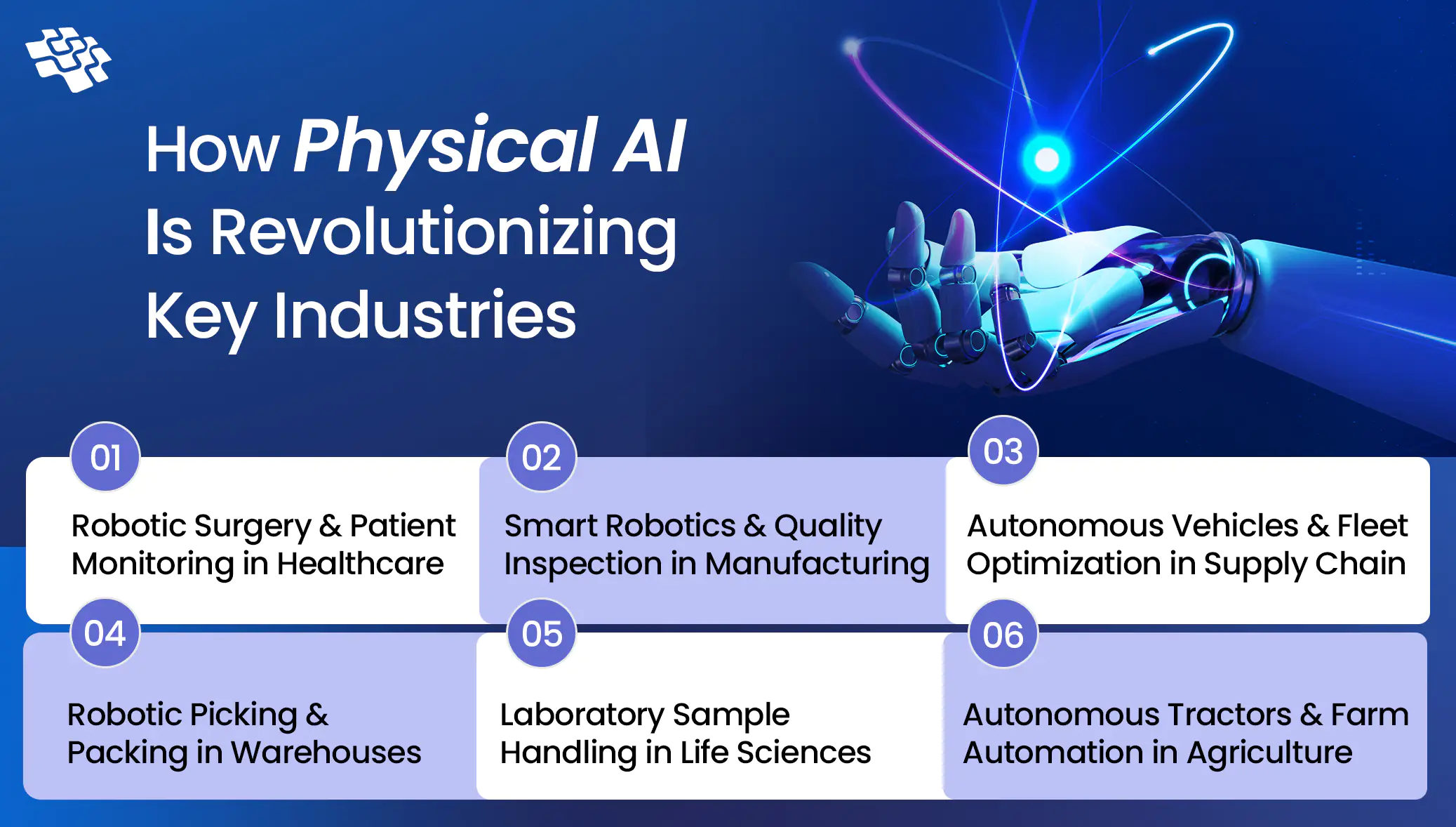
Physical AI Use Cases: Real-World Applications, Examples, and Benefits Transforming Modern Industries
What if intelligent systems could do more than just process data and interact digitally? What if they could move, pick up objects, and perform real-world tasks in laboratories, factories, and warehouses?
Stay In the Know
Get Latest updates and industry insights every month.